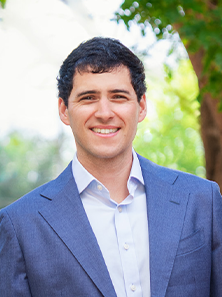
Aaron H. Rodwin
Assistant Professor
What I do
I am passionate about partnering with young people living with serious mental health conditions to develop services and supports that are engaging, culturally relevant, and grounded in what recovery means to them. My work seeks to understand the factors that shape mental health and recovery for this population, and to reimagine what youth-oriented mental health care could look like, drawing on music and other creative approaches.Specialization(s)
mental and behavioral health, trauma, intervention research, children and youth, marginalized populations
Professional Biography
Aaron H. Rodwin, PhD, LCSW, is an assistant professor at the Graduate School of Social Work. His research focuses on understanding and improving mental health for marginalized young adults diagnosed with serious mental illnesses (SMI), particularly schizophrenia-spectrum conditions. His work centers on two interrelated areas: investigating the social and contextual factors that contribute to mental health inequities and shape recovery, and developing psychosocial interventions to improve service engagement and outcomes. He has a particular interest in music-based interventions as a youth-oriented, culturally responsive, and trauma-informed approach to advance these goals.
Rodwin's research interests grow out of his clinical experience in community mental health, where he worked within systems that often struggled to engage marginalized young adults with SMI and provide culturally relevant, trauma-informed services. This sparked his interest in understanding the factors that produce disparities and shape mental health and recovery. It also motivated him to improve the quality of care by partnering with individuals with lived experience to co-create novel interventions that align with youth culture and preferences.
Rodwin has published his research findings in outlets including the Journal of Adolescent Health, Journal of Affective Disorders, Stigma and Health, Child and Adolescent Social Work Journal, and Psychiatric Rehabilitation Journal. Prior to joining the faculty at GSSW, Rodwin completed his doctoral dissertation, which examined how music engagement may impact recovery among marginalized young adults diagnosed with SMI. His research was supported by a Ruth L. Kirschstein National Research Service Award from the National Institute of Mental Health (NIMH) and the 2025 Society for Social Work and Research (SSWR) Doctoral Fellows Award. Rodwin brings over seven years of clinical practice as a therapist and clinical supervisor, having worked with youth and adults across community-based outpatient and hospital settings.
Rodwin's research interests grow out of his clinical experience in community mental health, where he worked within systems that often struggled to engage marginalized young adults with SMI and provide culturally relevant, trauma-informed services. This sparked his interest in understanding the factors that produce disparities and shape mental health and recovery. It also motivated him to improve the quality of care by partnering with individuals with lived experience to co-create novel interventions that align with youth culture and preferences.
Rodwin has published his research findings in outlets including the Journal of Adolescent Health, Journal of Affective Disorders, Stigma and Health, Child and Adolescent Social Work Journal, and Psychiatric Rehabilitation Journal. Prior to joining the faculty at GSSW, Rodwin completed his doctoral dissertation, which examined how music engagement may impact recovery among marginalized young adults diagnosed with SMI. His research was supported by a Ruth L. Kirschstein National Research Service Award from the National Institute of Mental Health (NIMH) and the 2025 Society for Social Work and Research (SSWR) Doctoral Fellows Award. Rodwin brings over seven years of clinical practice as a therapist and clinical supervisor, having worked with youth and adults across community-based outpatient and hospital settings.
Degree(s)
- Ph.D., Social Work, New York University, Silver School of Social Work, 2026
- MSW, Social Work, New York University, Silver School of Social Work, 2018
- BA, Sociology, Hofstra University, 2015
Licensure / Accreditations
- Licensed Clinical Social Worker (LCSW)
Professional Affiliations
- Society for Social Work Research (SSWR)
Research
My program of research focuses on understanding and improving mental health and recovery for marginalized young adults diagnosed with serious mental illnesses (SMI), particularly those living with schizophrenia-spectrum conditions. In particular, my work focuses on two interrelated areas: (1) investigating the social and contextual factors that contribute to mental health inequities and shape recovery, and (2) developing psychosocial interventions to improve service engagement and outcomes. Informed by my clinical practice experience, I have developed a particular interest in music-based interventions as a youth-oriented, culturally responsive, and trauma-informed approach to improve service engagement and recovery.
Areas of Research
Youth and young adults
Serious mental illness
Mental health services and interventions
Social determinants of health
Featured Publications
A Systematic Review of Music-Based Interventions to Improve Treatment Engagement and Mental Health Outcomes for Adolescents and Young Adults. (2022). . Child & adolescent social work journal : C & A, 1–30.
Childhood adversities and suicidal ideation among young adults with serious mental illnesses: The mediating roles of perceived stress, dispositional hope, and mental health hope. (2025). . Journal of affective disorders, 368, 820–828.
Prevalence and Geographic Variation of Serious Mental Illness Among Young Adults Enrolled in Medicaid in New York State. (2025). . The Journal of adolescent health : official publication of the Society for Adolescent Medicine, 77(3), 484–491.
Perspectives on the implementation and collaborative facilitation of an intervention to engage young adults in psychiatric rehabilitation. (2024). . Psychiatric rehabilitation journal, 47(2), 142–149.
Pahwa, R. (2025). Stigma Among Historically Marginalized Young Adults with Serious Mental Illnesses: A Mixed Methods Study. Stigma and health, 10(1), 50–62.
Emotional Expression and Mental Health Support in BTS Fandom Communities Using Natural Language Processing on YouTube Comments: Cross-Sectional Study. (2026). . JMIR infodemiology, 6, e74397.
Impact of a brief intervention to improve engagement in a recovery program for young adults with serious mental illness. (2022). . Schizophrenia research, 250, 104–111.
Revisiting the policy ecology framework for implementation of evidence-based practices in mental health settings. (2023). . Implementation science : IS, 18(1), 58.
Methodologies to Advance a "Science of How": Identifying and Engaging Intervention Targets and Outcomes. (2022). . Psychiatric services (Washington, D.C.), 73(9), 1039–1046.
Black and Latinx Foreign- and US-Born Young and Emerging Adults Living with HIV: Examining Social Ecological Risk Factors and Their Association with Depression, Post-traumatic Stress Disorder (PTSD), and Comorbid Depression/PTSD. (2026). . Journal of racial and ethnic health disparities, 13(4), 2812–2826.
Awards
- Ruth L. Kirschstein National Research Service Award, National Institutes of Health (NIH)/National Institute of Mental Health (NIMH)
- SSWR Doctoral Fellows Award, Society for Social Work and Research (SSWR)