MSW Field Education and Internship Placement
This page contains general information about field education for all MSW programs. Visit the individual program pages for more specifics and for contact information by program.
Field Education Team —
Below are field contacts listed by common topics or processes. Please reach out to the person who oversees the area with any questions.
| Topic or Process: | Denver Campus | MSW@Denver | Four Corners | WestCo |
| International Internships | Kate.Ross@du.edu | Kate.Ross@du.edu | Kate.Ross@du.edu | Kate.Ross@du.edu |
| Experiential Learning Cloud (field database for all four programs) | field@du.edu or ELC ticket links below | field@du.edu or ELC ticket links below | Carla.Hase@du.edu or ELC ticket links below | Erin.Leazer@du.edu or ELC ticket links below |
| Duplicates (Internship in Same Place for Two Years) | Lexxus.Washington@du.edu | Lexxus.Washington@du.edu | Carla.Hase@du.edu | Erin.Leazer@du.edu |
| Field Exceptions | Channing.Spears@du.edu | Erin.E.Clark@du.edu | Carla.Hase@du.edu | Erin.Leazer@du.edu |
| Place of Employment (POE) | Channing.Spears@du.edu | Channing.Spears@du.edu | Carla.Hase@du.edu | Erin.Leazer@du.edu |
| Program Transfer | Complete this Program Transfer Request Form | Complete this Program Transfer Request Form | Complete this Program Transfer Request Form | Complete this Program Transfer Request Form |
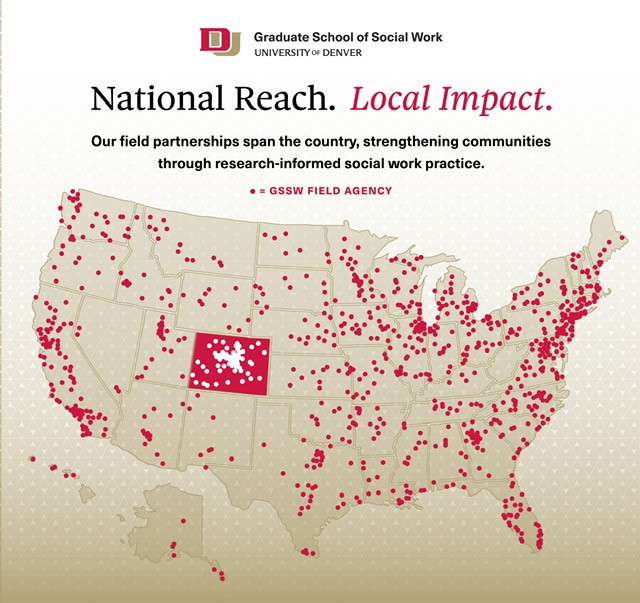
National Reach, Local Impact
Field Resources - All Programs
Important field resources for all programs are linked below.
- Field Calendars
- Field Education Manual
- Experiential Learning Cloud (formerly Tevera) - Field Database
- Financial Support for Field Placements
- Incoming Student Field Orientation PPT Slides (Fall 2026)
- Field Evaluation Ratings and Application by Term
- Grading Guidance: Hours, Competency and Field Course Assignments
Field Policies - All Programs
It is imperative that students read and understand the policies that govern the field experience. The first place to look for information is in the Field Manual. Review the manual for information on:
| Field Criteria | Roles & Responsibilities |
| Field Readiness | Dual Roles |
| Problem Resolution | Change of Internship |
| Private Practice/Clinical Counseling | Background Checks & Attestations |
| Paid Placements/POE | Special Arrangements |
- Place of Employment (POE) Internships
- Field Readiness Assessment
- Private Practice and Clinical Counseling Settings
- Duplicate Internships
Field Requirements - All Programs
Important information about field requirements for all programs are linked below.
- Foundation Competencies Practice Behaviors
- Concentration/Advanced Standing Competencies Practice Behaviors
- Foundation (Generalist) Field Evaluation Rubric
- Concentration/Advanced Standing (Advanced Practice) Field Evaluation Rubric
- Blank Foundation (Generalist) Learning Contract
- Blank Concentration (Advanced Practice) Learning Contract
Experiential Learning Cloud (ELC) - General Resources & Site Placement Process Tutorials
- To finalize a field placement, students must complete the Site Placement Process (SPP) in Experiential Leanrning Cloud (ELC). The SPP includes completing a field confirmation form, connecting to the agency and connecting to agency supervisors in the GSSW field database, ELC.
- Students can’t begin a placement or accrue hours until the SPP is complete and they're registered for field. This applies to students in all four GSSW programs.
- Not sure who to reach out to with your ELC question? Check out this infographic…
- Contact ELC's Support Team
- GSSW Field Team - ELC Support Ticket
- ELC Login Page
- FY SPP – How to Search and Complete Pre-Application Tasks
- FY SPP – How to Confirm a Placement in ELC
- CY/AS SPP - How to Search and Complete Pre-Application Tasks
- CY/AS SPP – How to Confirm a Placement in ELC
- Learning Contract Tasks Flow Into Evaluation Workaround
- Submit End of Quarter Hours for Approval
Financial Support for Field Placements
Although unpaid placements are the norm nationwide, at GSSW we participate in a variety of opportunities for students to receive scholarships or in some cases stipends related to their field placement. In the 2024-2025 Academic Year approximately 18% of students indicated receiving some form of compensation or employment within the site. Field education is a requirement of the MSW degree program and as such, it is first and foremost a learning opportunity that is evaluated similar to an academic course. Students should not expect payment within MSW field placements, however inquiring about financial options within GSSW's placement sites often yields some additional support for students who choose to prioritize this element of field experience. Focusing on the skills and areas of practice students want to pursue is GSSW's top priority in terms of providing students with high quality experiences to learn social work competencies.
| Topic or Process: | Denver Campus | MSW@Denver | Four Corners | WestCo |
| Questions about stipends | Kate.Ross@du.edu | Kate.Ross@du.edu | Carla.Hase@du.edu | Erin.Leazer@du.edu |
-
Field Education in Place of Employment
Students can complete their field requirements in their place of employment if appropriate graduate-level learning and supervision are provided. Students are encouraged to seek out paid employment as internship opportunities and work with the GSSW Field Office to determine if they can be approved as an internship site. Review the process. In 2021–22, 194 Denver Campus and MSW@Denver students took advantage of employment-based field placements.
-
Work Study in Internship (Colorado residents only):
If you have work study funds as part of your federal financial aid package, you may ask your internship agency if they are interested in hosting you as a work study student. Here is the information your agency will need. Agencies must be deemed eligible by the Office of Student Employment and meet federal criteria for eligible agencies.
-
Paid Internship Acknowledgement & Risk Consent
If a student receives any compensation for their field placement, there are required forms and acknowledgements that need to be completed prior to the start of the internship experience.
Paid Acknowledgement & Risk Consent
The Paid Acknowledgement & Risk Consent form needs to be completed if a student is receiving compensation. The form is located in ELC (formerly Tevera) in the "optional" section of the site placement process (within the pre-application tasks). If you have not completed the form, and are being paid, please let your field liaison know so they can guide you on completing the form.
If a student receives any payment directly from the agency (whether paid hourly, salary, one-time stipend, or any other payment for the student’s work/services), the internship/practicum is considered a paid internship/practicum for purposes of workers’ compensation. Note: Reimbursement of actual expenses is NOT payment for the student’s work/services.
- If the student is paid with work study or other federal, state, county funding funneled through DU or the agency, see below.
- If the student is paid, the Agency should cover the student with the Agency’s workers’ compensation insurance.
- If the Agency pays the student but classifies them as a non-employed (for example, independent contractor), then the student may not be covered by workers’ compensation insurance.
- Students can choose to proceed in a paid internship/practicum without workers’ compensation coverage.
If students agree to accept a stipend or some form of payment, they may be required to acknowledge the following:
Employment Status and Compensation
- The internship is a paid placement with compensation provided by the Agency. The University has no obligation to pay or supplement any compensation associated with the placement.
- The student is not considered an employee of the University of Denver (“DU”) for purposes of this internship placement.
Worker’s Compensation Coverage
The Placement Agency has not agreed to provide Worker’s Compensation coverage for the student during the internship.
- DU’s Worker’s Compensation policy does not provide coverage for students during paid internship placements.
- The student understands and assumes the risk associated with participating in the internship without Worker’s Compensation coverage.
Professional Liability Insurance
- The Placement Agency does not maintain professional liability insurance coverage applicable to the internship.
- DU provides professional liability insurance for the student during the internship placement; however, this coverage applies solely to the student’s actions and does not extend to the Placement Agency or its employees.
- The student accepts the risks associated with participating in an internship where the Placement Agency does not maintain professional liability insurance.
Risk Assumption and Waiver
By signing the paid acknowledgement form, the student voluntarily agrees to:
- Assume all risks associated with the internship, including but not limited to those arising from the lack of Worker’s Compensation coverage and/or the absence of professional liability insurance by the Placement Agency.
- Release and hold harmless the University of Denver, its trustees, officers, employees, and agents from any claims, demands, or causes of action arising out of or related to the student’s participation in the internship.
- Indemnify the University of Denver against any claims, losses, or damages resulting from actions taken by the student during the internship.
Workers’ Compensation Procedures
Injury Reporting & Workers' Compensation:
All work-related injuries that occur while completing fieldwork should be reported.
Steps to report an injury:
All forms can be found on ERM’s Injuries & Workers’ Compensation website
(University of Denver Risk Workers Compensation).
- For life-threatening or serious injuries, please seek immediate treatment. If on campus, call 911, and if possible, call Campus Safety at 303-871-3000.
- Review and sign a copy of the Workers’ Compensation Medical Providers list (student reviews & signs).
- Complete the Employee Report of Injury form (student fills out).
- Your supervisor needs to complete the Supervisor’s Report (placement supervisor fills out).
- Within 24 hours of the injury, all forms must be emailed (scan or photo) to ERM at risk@du.edu.
- If you seek medical treatment and want it to be covered by workers’ compensation benefits, you must seek treatment at a provider listed on the Workers’ Compensation Medical Providers list signed in step 2.
DU students may not transport injured parties.
For more information, please see DU’s Injuries & Workers’ Compensation website (University of Denver Risk Workers Compensation) or your state’s workers’ compensation website (Colorado’s is Colorado Government Division of Workers Compensation).
Unpaid Internships:
If you are working in an unpaid internship and experience a work-related injury, you may be covered by the University of Denver’s workers’ compensation insurance. Please follow the steps to report an injury above.
If you are in an unpaid internship in OH, ND, WA, WY, these four states require businesses to participate in a state-specific workers' compensation program. DU now offers coverage in ND, OH, and WA if Risk is informed of the students in unpaid internships in these states. Coverage in these states is done on an individual basis, so it is important to keep Risk informed of the unpaid interns in those states. If you are in an unpaid internship in one of these three states, email risk@du.edu with:
- Student name
- Social Security Number
- DU ID#
- DU email
- start date of the internship
- address of agency (zip code included)
- some states require the number of hours worked each month, so tracking time on your timesheet is essential and will be reviewed quarterly by the ERM
Wyoming will not allow DU to pay for workers compensation insurance, and thus, students in unpaid internships in Wyoming will need to sign the Risk Acknowledgement form indicating that they are aware that DU cannot provide workers compensation for unpaid internships.
Paid Internships:
If you are injured while working in a paid internship, please follow your agency’s workers’ compensation procedures and report your injury to your field liaison and risk@du.edu. Paid internships are not eligible to be covered by DU’s workers’ compensation insurance; however, you do still need to report your injury to DU and follow the steps to report an injury above.
All injuries should be reported. Seeking medical treatment is optional, but if you want your medical treatment to be covered by workers’ compensation, you must go to an approved medical provider listed on the Workers’ Compensation Medical Providers list. If you delay in seeking treatment at an approved medical provider, it may be harder to determine if your injury is work-related.
-
Colorado Workforce Development Stipends
GSSW is among a select group of universities nationwide and within Colorado to be awarded federal and state funding to provide stipends to assist students with the cost of learning. Learn more about GSSW stipends.
-
Advocacy Efforts
DU has been engaged with the Behavioral Health Administration Workgroup to provide more pathways for student stipends.
Students as Learners
At GSSW, MSW field education is a structured, hands-on learning experience that allows students the opportunity to learn and demonstrate social work competency under the guidance of a professional social worker. The competencies and learning requirements are like academic classes, except the learning is experiential instead of classroom based. Social work students engage in an apprenticeship model similar to other disciplines such as teaching and nursing. Students are acting in the role of a learner, not an independently practicing social worker. Internships are a required part of every social work graduate program. Please read the statement on internships by the Council on Social Work Education.
Reciprocal Service
In keeping with our profession’s mission and code of ethics, there is also a service component to the active learning in field internships. We honor both the service of the agency and supervisors who give their time outside of their paid duties to mentor, train and supervise student learners and the students who, while engaging in learning and skill development, also provide a service on behalf of the agency. This reciprocal service benefits clients and the community at large and bolsters social work through student development of ethical and competent practice.
Request for Duplicate Internship
Duplicate Internships
Students interested in completing their Concentration/Advanced Practice or Advanced Standing internship in the same agency where they completed their Foundation/Generalist Practice internship are pursuing what we call a duplicate internship and must go through an approval process.
Prior to submitting the Request for Duplicate Internship form in ELC, students must consider:
- Whether their learning needs for their Concentration/Advanced Practice requirements can be met in this agency.
- The Concentration/Advanced Practice internship must provide the student with experiences that are distinctly different from those of the Foundation/Generalist Practice internship.
- Adequate MSW supervision for the second-year internship. Preferably with a different field instructor to gain exposure to a different supervision relationship and style.
Duplicate Approval Deadline:
- Duplicate form in ELC needs to be submitted six weeks prior to your scheduled field start date.
Duplicate Approval Process:
- Students, please reach out and notify your field team contact that you are planning to pursue a POE internship for formal notification and further guidance on the process.
- Students planning to pursue a duplicate internship will work with their field contact and must submit the Duplicate form in the ELC system, then meet with a field team member for an approval meeting.
Place of Employment Internship Process
Place of Employment (POE) Internships
A POE internship is when a student intends to complete their internship hours at a setting that is also their place of employment (POE). Students that plan to pursue a POE internship must go through the POE approval process to ensure:
1) Student learning needs and goals can be met
- Consistent engagement with the nine social work competencies/associated practice behaviors
2) Student learning is being prioritized
- Ability to and support in applying a social work lens to the learning tasks identified within the employment setting
- Available supervisory support for skill development, feedback and evaluation
Overview of the POE Approval Process
The POE approval process takes time, so please start the process as soon as possible. Students will:
1) Review available POE structures and basic internship requirements
- Total hours needed/hours per week
- Supervisor and supervision requirements
- How current employment role or setting provides or does not provide learning tasks connected to the nine social work competencies/associated practice behaviors
2) Meet with POE agency supervisor(s) to create the plan for the POE internship
3) Submit a POE form in the ELC system with details of the POE internship plan and designate one supervisor to sign it
4) Meet with a GSSW field team member for a POE approval meeting
- All steps of the POE approval process must be completed before a student can begin gaining hours for the internship.
- Students, please reach out and notify your field team contact that you are planning to pursue a POE internship for formal notification and further guidance on the process.
- Note: If a student’s POE agency is new to GSSW, meaning not a currently affiliated internship partner or listed in ELC, the student must submit a referral for the agency to then go through the approval and partnership process.
- GSSW will work to explore provided POE proposals, but completing a POE internship is not guaranteed. All settings proposed for an internship experience will go through an approval process and must meet all CSWE and GSSW programmatic requirements.
- Refer to the POE checklist linked at the start of this section (affiliated or not affiliated) as needed for guidance on steps in the POE approval process.
Place of Employment Frequently Asked Questions
-
What are the available POE structures?
There are three options that agencies and students can pick from related to the structure of a POE internship. Which structure is chosen can depend on agency policies related to employees completing internships in the setting, and/or what types of learning tasks exist within a student’s employment role and whether the available tasks will allow them to engage in work connected to the nine social work competencies/associated practice behaviors.
1. Internship activities and job activities are separate.
When possible, this is recommended, as you are able to have a completely different learning experience (i.e., interning in a different department within the agency, focusing on a different population within the agency, etc.) in addition to the experience you are getting within your job. This option requires building out a schedule of when you will complete your job hours vs. your internship hours.
2. Some internship activities are within the job, some are outside of the job.
You can break up your hours, applying some parts of your job to the internship (they must meet the competencies) and spending time interning in a different department/with a different population in your agency. This option requires building out a schedule of when you will complete your job hours vs. your internship hours, breaking down how many hours will be within the job and how many hours will take place outside the job.
3. Internship activities all take place within the job.
Students often work in jobs that are already social-work-type positions, and the competencies can be met within the current position. An important piece to consider in this option is ensuring that your role as a student learner is still prioritized.
-
What are the requirements for supervisors and supervision?
Supervisor Requirements
Every GSSW intern is required to have a MSW Field Instructor identified as a supervisor for their internship.
MSW Field Instructor = someone that has an MSW degree and 2+ years of post-graduate work experience.
Task Supervisor = non-MSW supervisor that is on site at the agency, available to oversee a student’s day-to-day tasks, and has the educational background and/or work experience to guide student learning in the tasks identified for the internship. *Only required if there is no on-site MSW field instructor available at the agency.
Agencies will be asked to search within their networks (departments, Board members, longtime volunteers, etc.) to identify an MSW Field Instructor for the internship. If after this search there is no one within the agency’s network that holds these credentials:
1) The agency will be required to identify an on-site Task Supervisor to provide supervision for the internship.
2) The agency will be asked to formally request that GSSW provide an Off-site MSW Field Instructor (OSFI) for the student’s internship.
MSW@Denver students, connect with your Placement Specialist if this is needed
Denver Campus students, connect with either your Field Advisor or the field office if this is needed
Four Corners and West Co students, connect with your Assistant Program Director or Assistant Director
Many agencies will have someone on staff and on-site that meet the MSW Field Instructor requirements, meaning most students will have a supervision setup with only a MSW Field Instructor identified as their supervisor for the internship. The inclusion of a Task Supervisor is only required if there is no on-site MSW field instructor available at the agency.
Supervision Requirements
Every GSSW intern is required to have one hour of supervision on a weekly basis.
If a student just has an on-site MSW Field Instructor as their supervisor, that person will provide the student with one hour of supervision on a weekly basis.
If a student has an on-site Task Supervisor and an off-site MSW Field Instructor (OSFI) as supervisors, the two will alternate in providing the student with one hour of supervision on a weekly basis for the 10-week quarter (i.e., week 1 = Field Instructor, week 2 = Task Supervisor, week 3 = Field Instructor, etc.). This means both the Task Supervisor and the Field Instructor will meet with the student for one-hour of supervision at least 5 times per quarter.
If a student’s MSW Field Instructor or Task Supervisor is also their employment supervisor, internship supervision must be scheduled separately from employment supervision.
-
What kinds of tasks am I required to do for the internship?
Students must engage in learning tasks with a direct connection to the nine social work competencies and their associated practice behaviors. Please review the Foundation/Generalist Practice and/or the Concentration/Advanced Practice competencies by scrolling up on this webpage, under “Field Requirements- All Programs.”
Determine which practice behaviors have a direct connection to tasks you complete within your employment role and identify any practice behaviors that are not covered by your employment responsibilities. If needed, discuss with your agency supervisor(s) a plan for your engagement in learning tasks considered outside of your employment role so that you will meet all nine social work competencies for the learning experience.
-
Who should be involved in filling out the POE form in ELC?
Best practice is for students to fill out the POE form during or after meeting with their direct employment supervisor and individual(s) at the agency who would be considered either the MSW Field Instructor or Task Supervisor for the internship.
Students will then choose either their employment supervisor, Field Instructor or Task Supervisor to review and sign off on the POE form when submitting it.
-
What if I am not sure about how my learning activities connect to the social work competencies/practice behaviors?
The practice behaviors listed with each competency help to connect more specific learning tasks. Do your best to list the specific activities you feel fit each practice behavior. Part of the approval meeting will be reviewing these if further guidance is needed. Please come to your POE approval meeting prepared with questions so the staff or faculty member will be able to further assist.
-
If I am doing my internship hours within my job and have provided my job description, do I still need to list learning activities in the competencies section?
Yes. CSWE requires that all students completing POE internships provide specific information on how their learning activities align with the social work competencies. Break down the tasks within your job description and connect them with specific practice behaviors.
-
What if I am doing my Concentration/Advanced Practice POE internship at the same agency where I did my Foundation/Generalist Practice internship?
This is called a duplicate POE internship, and the POE approval process must still be followed.
Students pursuing a duplicate POE internship will complete the “Field Internship in Place of Employment: Advanced Practice (Concentration Year/Advanced Standing)” form in ELC and must complete the “Part D: Same Agency Information” section.
This is where a student will detail how the Concentration/Advanced Practice internship will differ from their Foundation/Generalist Practice internship, showing expansion into new learning opportunities and/or further opportunities for leadership and autonomy.
Disability Accommodations Field
Students must have letters of approved accommodation (LOAA) issued by the university Student Disability Services (SDS). Please note that accommodations from SDS must be officially approved and documented to be utilized in the field practicum, and that accommodations cannot be retroactively applied. Students who have disabilities or medical conditions and who want to request accommodation are encouraged to contact DU Student Disability Services (SDS).
Requests to Open New Agencies or Referral of New Agencies
We partner with 700+ agencies to streamline the internship search experience. However, as a graduate student, you may elect to refer a new site for GSSW to review and approve. Please be mindful that option could impact your field start timeline.
Please note the placement process on average can take anywhere from 6-10 weeks and opening a new site may extend this timeframe
There is no guarantee that an affiliation agreement can be reached with a site, however, GSSW will keep students informed of delays or challenges in the process
All referrals are subject to GSSW field team review and must meet CSWE and GSSW criteria for approval.
For further information, please read the Requests to Open New Agencies or Referral of New Sites section under Student Field Placement Process in the Field Manual linked above.
Extended Field Learning
-
Approved Extended Field Learning (EFL) Sites
Approved Extended Field Learning Sites
- Some internships require students to be in the field for extended hours beyond the minimum
hours required by GSSW, which may allow the student to register for additional field credits. - These agencies must be carefully pre-approved by the Field office to ensure that they are
offering substantial field learning to warrant additional field credits. - If you do not see the site listed as already approved for extended field learning, check in with your field placement specialist (MSW@Denver), field advisor (Denver Campus) or assistant director (Four Corners or Western Colorado).
- Some of the sites may have been approved previously or may need to go through an
application process. Students may not add additional field credits in any given quarter unless
they are in an internship at a pre-approved extended field learning site. - If a GSSW student elects to use their allotted elective credit to complete additional field
learning, this means that they will register for extra field credits instead of, for example, taking
Human Sexuality (one of the many GSSW electives offered). - The Field Office recommends that agencies carefully consider whether their additional field
learning is comparable to the education a student will receive in an academic class before
completing this form. Agencies may request approval for up to 6 credit hours of approved
additional field learning. Agencies must specifically outline the learning available to warrant the
hours and credits below. - To be approved for extra hours for credit, agencies must demonstrate additional learning that
allows students to further develop their skills and demonstrate required social work
competencies. Agencies may offer a combination of:
• additional extensive required training
• additional extensive required supervision
• required certifications
- Some internships require students to be in the field for extended hours beyond the minimum