Addressing Social Injustice
Author(s)
GSSW
Communication Team
Throughout her social work career, MSW alumna Sarie Patterson has worked to center justice in policy and practice
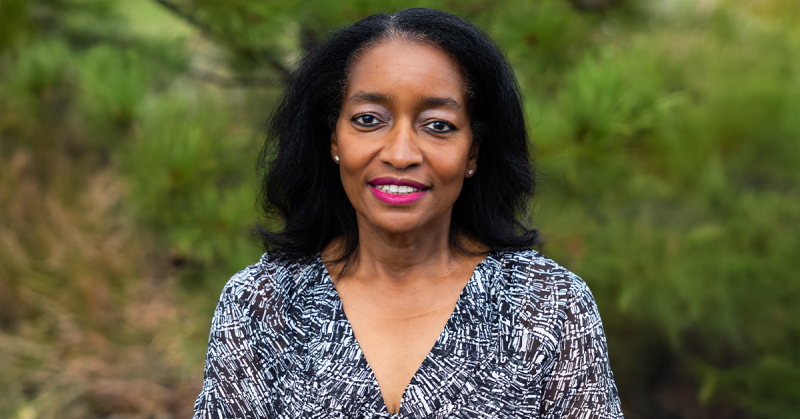
Whether she was working in child protection, K-12 education, private practice, or in service to her community, University of Denver Graduate School of Social Work alumna and GSSW Board of Advisors member Sarie Patterson (MSW ’94, LCSW, PhD Education ’16) has devoted her career to addressing social injustice.
Although many may look at today’s social problems and governmental changes and see catastrophe, Patterson says she sees opportunity: Rather than trying to fix policies, practices, and systems that never worked well, social workers can create something entirely new and more just.
She says, “We worry about what we’re not able to do versus focusing on what we can do. A lot of people are in despair and are frustrated and exhausted by what we’re currently experiencing. As we see the destruction of so many programs and so many supports, there’s also opportunity there, because some of the supports and programs that were in place didn’t address all of the needs, or they didn’t address certain groups. There is going to be opportunity to rebuild, and we can rebuild better. We can address some of these injustices as we’re rebuilding.”
Patterson has taken that approach herself throughout her 30-year career developing innovative approaches in child protection, family functioning, and education.
Initially, Patterson started as an undergraduate business major and worked for a large accounting firm in Houston, Texas. She recalls thinking a lot at the time about the “haves and have-nots.” She was working with affluent colleagues while entire neighborhoods of people nearby were “really suffering and didn’t have anything.”
Bothered by the disparities she was seeing, Patterson switched her major to social work, intending to work with children. She returned to the Denver area to care for an aging family member and finished her bachelor’s degree at Metropolitan State University of Denver, where she later went on to teach.
After finishing her MSW at GSSW, Patterson went to work for Denver Human Services, working in a variety of roles, including child protective services investigative intake, supervising foster homes, and working with youth in therapeutic foster care.
Seeking a job that she could balance with her own parenting responsibilities, Patterson moved to Denver Public Schools (DPS), eventually becoming licensed as a school principal. She led several initiatives for the district, including a $4.5-million Mental Health Expansion Program that included developing tools and resources to assess and support student mental health and providing oversight of expansion of mental health services to K-12 schools districtwide. Patterson created the Needs-Based Assessment Data Collection Tool to identify students’ mental health needs, available student support, and services. She also wrote the Mental Health Support, Services, and Resource Guide disseminated across DPS.
As a liaison among DPS, Denver Human Services, Denver Police Department, and the Denver District Attorney’s Office, Patterson coordinated policy implementation, crisis response, and professional development training on student safety and mandated reporting policies and procedures. She also planned and organized a human trafficking conference with the FBI, Denver District Attorney’s Office, Denver Human Services, Denver Police, and school district personnel.
With a strong interest in assessment as a tool for social change, Patterson pursued her PhD in education. She says, “Data better defines problems and their potential solutions.” In partnership with the Colorado Department of Education, her dissertation analyzed more than 17,000 student cases to develop actionable steps addressing social injustice in education.
Patterson’s service work is extensive. Appointed by former Colorado Gov. John Hickenlooper, she served as a board member of the Colorado Child Protection Ombudsman Office. She also served on the board of the CASA of Adams & Broomfield Counties, which provides volunteer advocacy and support for at-risk children and youth. Currently, she is a member of the governing board for the STEAD School, a student-led charter school focused on experiential learning in science, technology, environment, agriculture, and systems design. She is also working with GSSW to bring MSW field placement students to the school and will serve as their supervisor.
In 2025, Patterson served as pro bono project manager for the 2025 Black Health Summit. Hosted by GSSW in partnership with Connect for Health Colorado, the summit brought together state and local leaders, health care providers, policymakers, and community advocates to foster dialogue, share insights, and develop actionable strategies for a healthier future. As a current member of GSSW’s Board of Advisors, Patterson helps to elevate the school’s visibility, strengthen and broaden its community connections, and increase financial support for students and programs.
As she looks toward the future and ways to continue making a positive impact, Patterson says she is also guided by the past. “I come from ancestry that have always had challenges, that have always had to make do. And they did. To me, that’s very promising: They would make do with a lot less, and I have a lot more resources at my disposal than they did. So instead of being overwhelmed by what we’re seeing, I always try to take it down to manageable pieces and look in my immediate environment. How can I help in my immediate surroundings?”
She adds, “This one thing can lead to something else that can lead into something a lot bigger.”