Community-Engaged Research
Author(s)
GSSW
Communication Team
PhD student Taylor Coats receives prestigious Center for Religion and Cities Public Scholarship Fellowship
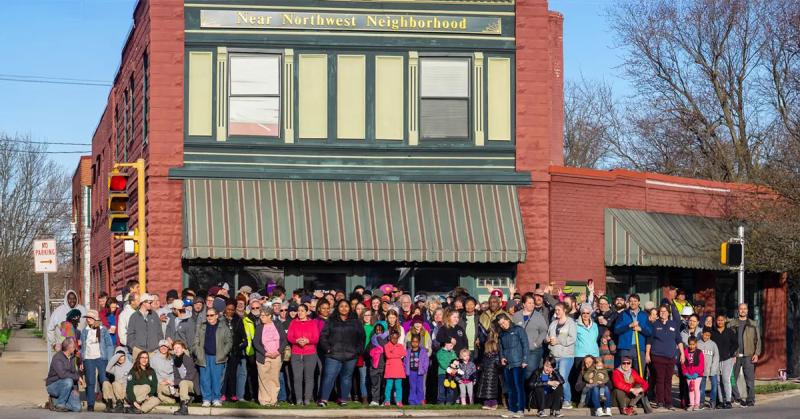
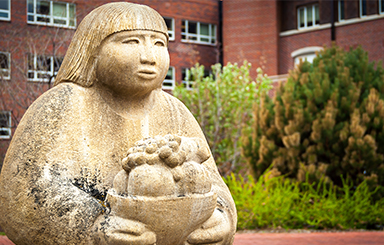
PhD student Taylor Coats is examining how engagement with the neighborhood organization Near Northwest Neighborhood Inc. (pictured) in South Bend, Indiana, influences residents’ perceptions of neighborhood safety, built environment, social capital, and civic engagement.
Alumna and PhD student Taylor Coats (MSW ’17) describes herself as a social worker “through and through.” She always knew that she wanted to be a social worker, however, when she graduated with her MSW from the University of Denver Graduate School of Social Work (GSSW), she was unsure what her next steps would be. Although she was interested in environmental social work, in Indiana where she lived, the only available social work positions were for caseworkers or therapists.
Coats began working as a therapist but longed to return to macro social work. She joined a public health department as the assistant director of health equity. It was a new position responsible for creating a network of community health workers and “health cafes” (health care information delivered in casual community settings), conducting community assessments, and working in the policy arena. With funding from the Centers for Disease Control and Prevention, Coats was asked to train other programs in her department’s approach to community engagement. She was uneasy, however, because “we knew it was working, but we didn’t know why,” and accessing additional information was difficult because so many resources were behind academic paywalls.
Her drive to answer questions about “why” led Coats back to GSSW to pursue her PhD in social work. Coats says GSSW was a good fit because it has a strong focus on environmental social work, pedagogy, and qualitative methods, including antiracist/antioppressive and critical approaches. “GSSW has a reputation for being a school that encourages community-engaged ADEI [antiracism, diversity, equity, and inclusion] work that really centers communities, equity, and other ways of knowing and epistemologies.”
Broadly, Coats’s research focuses on “how we build community and mobilize those communities to address local issues.” She examines how communities bridge differences to address environmental and structural issues, and the emotional and relational aspects of collective care: “How do we support individuals who are doing that work?”
Her dissertation project, “From Connection to Perception: How Engagement with Place-Based Organizations Shapes Safety, Built Environment, Social Capital, and Civic Engagement,” is an investigation of how engagement in neighborhood organizations facilitates social ties and shapes residents’ perceptions of their neighborhood. Coats explains, “Place-based organizations such as neighborhood organizations support community well-being and foster neighborhood change. Contributing to residents’ sense of belonging and connectedness is essential to sustain engagement in neighborhood initiatives.”
Specifically, Coats is examining how engagement with the neighborhood organization Near Northwest Neighborhood, Inc., in her hometown of South Bend, Indiana, influences residents’ perceptions of neighborhood safety, built environment, social capital, and civic engagement. Guided by a community-based participatory research and community geography framework, the study assesses individual and network-level engagement pathways to determine whether personal engagement with a place‑based organization is associated with residents’ perceptions of neighborhood safety, built environment quality, trust/social capital, and civic engagement. Her research also explores whether residents’ social network members’ engagement with the organization affects neighborhood perceptions.
Coats’s dissertation research emerged from an earlier qualitative research class project in which she compared stories from people living in two South Bend neighborhoods. Despite similar rates of crime and other challenges, residents of one neighborhood had much more positive views of their community. Coats says, “Everybody who spoke really positively about their neighborhood had strong ties to [Near Northwest Neighborhood, Inc.]. They mentioned it in every interview. Residents of the other neighborhood didn’t have as strong of an impression of their neighborhood organization, and people didn’t really reference them.”
Coats approached Near Northwest Neighborhood, Inc., to find out if they were interested in learning more, and together they convened a community advisory board that helped design the quantitative study and develop the survey instrument and recruitment strategies. The board will assist in interpretation of findings through early fall as well.
Preliminarily, Coats says findings suggest that the influence of place-based organizations extends beyond individual participation, extending to network-based pathways within the neighborhood. She explains, “Findings demonstrate the importance of social network connection to the organization in shaping civic and social outcomes. Interventions and policies aimed at strengthening neighborhoods should foster relational connectivity and network engagement with neighborhood-based organizations in addition to increasing individual participation.”
In another recent project, Coats, PhD student Jax Heil, and GSSW Associate Professor Marquisha Lawrence Scott published a paper about the Eco Preacher Project, in which they examined how religious leaders engaged their congregations in discussions about environmental issues and stewardship.
At the Society for Social Work and Research annual conference in January, Coats co-presented a study exploring how social workers across three states experience environmental disasters and how environmental issues were showing up in their work.
Coats also presented findings from a project that explored the concepts of BIPOC radical healing, critical hope, and collective grief during political upheaval. For that project, focus groups with participants in the Spirituals Project choir surfaced the different ways people were processing grief around the nation’s political turmoil. She explains that the experiences of grief and resistance differed by racial identity, with BIPOC members considering historical trauma and resilience in their experiences of the current political turmoil. Coats adds that the Spirituals Project participants were navigating collective grief and ambiguous loss through avoidance, denial, and social withdrawal. They relied on African American spirituals as a source of personal solace and as an historical anchor that “connected them to a lineage of resistance and resilience.” The choir also provided a space for building meaningful relationships across differences, fostering healing and a commitment to civic engagement. According to Coats, “Culturally grounded, community-based spaces are vital for healing, resistance, and civic engagement, particularly in times of sociopolitical upheaval. Arts-based and affinity group models can foster cross-cultural connection, emotional resilience, and collective agency.”
Coats will present “Integrating Collective Grief into Social Work Education,” based on her Spirituals Project research, at the 2026 Council on Social Work Education Annual Conference.
In recognition of her deeply community-engaged scholarship, Coats was one of four scholars nationwide selected to participate in the 2026 Center for Religion and Cities Public Scholarship Fellowship, which brings together scholars engaged in community-led and community-engaged work to convene virtually, share experiences and lessons learned, and reflect alongside Center for Religion and Cities leadership.
Coats says, “[The fellowship has] been a really great experience, and very grounding. The academy prioritizes publication above all else, and for those of us that do public scholarship and community-engaged work, it can feel really invalidating at times. I’m doing things that matter, but the academy may not see it that way. So, to be with this group of people who are like, ‘Yeah, it does matter, and this is why what you’re doing continues to matter, even if it’s not acknowledged when you’re on the job market … the communities you’re serving and engaging with are reinforcing that.”
According to Coats, at the end of the day it is the communities she serves and collaborates with that matter most. Their questions and needs drive several other research projects Coats has in the works. “I have the privilege of being able to dream big and dream a lot because the community I work in is always dreaming.”