Protecting LGBTQIA+ Rights
Author(s)
GSSW
Communication Team
As executive director of One Colorado, alumna Nadine Bridges is advancing equality for LGBTQIA+ Coloradans
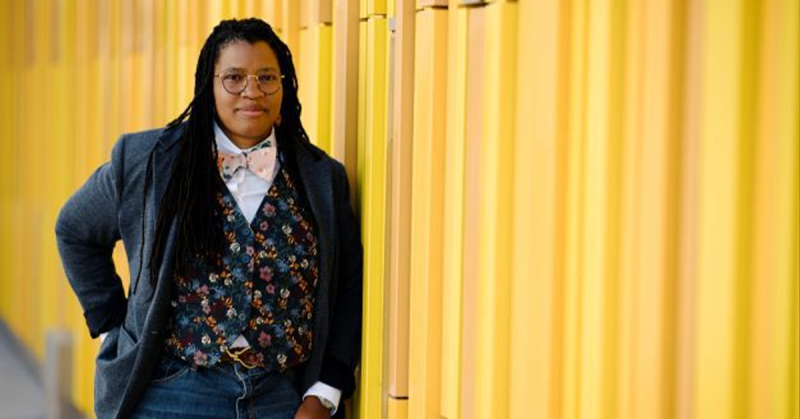
In 2020, when the COVID-19 pandemic and widespread protests of police violence were sweeping Colorado and the rest of the country, University of Denver Graduate School of Social Work (GSSW) alumna Nadine Bridges (MSW ’10) was helping to lead Boulder County’s pandemic response as manager of the county’s community health division. Her work there also spanned youth and young adult substance abuse and tobacco education and prevention, healthy parenting practices among teen parents, and increasing healthy behaviors and decreasing risky behaviors among LGBTQIA+ youth.
With the country at another inflection point, Bridges now serves as executive director of One Colorado, the state’s leading advocacy organization dedicated to advancing equality for LGBTQIA+ Coloradans and their families. Bridges joined the organization in 2021, becoming its first female and Black leader.
Although Colorado has some of the strongest LGBTQ+ protections in the nation, Bridges notes that One Colorado’s advocacy work is never done. “We are trying to defend the laws that we have while shoring up any gaps in protections of LGBTQ folks.”
Issues on the forefront include expanding the statute of limitations for harms caused by conversion therapy. Introduced in March 2026, Colorado House Bill 26-1322 would allow survivors of “sexual orientation or gender identity change efforts” (also known as “conversion therapy”) to file civil suits at any time, recognizing that the psychological harm of conversion therapy may not manifest or be recognized until decades later. Although Colorado banned conversion therapy in 2019, the U.S. Supreme Court recently overturned the law in a ruling that will affect more than 20 other states.
Meanwhile, Bridges says, One Colorado is gearing up to fight two anti-trans ballot measures that will go before voters in Colorado’s November 2026 statewide election. Ballot Initiative 110 would prohibit health care professionals from knowingly performing any surgery on a minor “for the purpose of altering biological sex characteristics” and would prohibit state and federal funding from being used to pay for gender-affirming procedures. Ballot Initiative 109 would add statutory language defining boys and girls based on physical anatomy, excluding transgender people. If the initiative passes, sports teams sponsored by schools or athletic associations would be required to designate those teams for men, women, or co-ed, and schools would be required to adopt policies implementing the initiative’s requirements.
Bridges says Colorado families should be free to make personal decisions without government interference. She adds, “These initiatives use the language of protection to advance a political agenda that threatens the dignity, safety, freedom, and belonging of our neighbors.”
She notes that attacks on trans rights are one more dangerous step on a slippery slope. “There has been an intentional attack on reproductive rights, bodily autonomy, immigrant rights. If we let one of these [rights] fall, they all can fall.” Bridges adds, “Colorado went from being the ‘hate state’ in 1992 [after voters passed Amendment 2] to being the great state now in 2026. We want to hold on to that. Coloradans love their freedom, they love fairness, and we want to make sure that they lean into that.”
Bridges continues, “Parents and medical providers should have a right to make decisions without government being involved. I believe that Coloradans in general don’t want government involved in that way. They want to respect the dignity and the worth of a person and have respect and love for the human condition.”
Bridges’s own respect and love for others was nurtured by her father. In a 2024 interview with Shoutout Colorado, Bridges recalled that her dad instilled confidence, empathy, and resilience in his children and emphasized the importance of supporting vulnerable populations. Today, Bridges brings a racial equity, social justice, and anti-oppressive lens to her work at One Colorado, where her accomplishments include ensuring that staff are paid above market value and increasing the percentage of Black and transgender/nonbinary/gender-expansive staff.
Alongside its political advocacy, One Colorado prioritizes health equity, working to improve health care access and reduce barriers to quality care for LGBTQ+ Coloradans. Recently, One Colorado introduced training for medical providers interested in providing gender-affirming care, and it is collaborating with organizations such as the Alexander Foundation to support families that need access to gender-affirming care.
One Colorado also hosts a Queer Youth Summit, as well as a Trans Changemakers Cohort and Families for Trans Liberation Cohort, all programs that help prepare lived-experience experts from across Colorado to build sustainable programs and support in their communities.
Bridges says that as a social worker leading a statewide nonpartisan advocacy organization, she routinely draws on the social work skill of meeting people where they are. She explains, “The majority of our work is public education, which means that I have to talk to everyone, regardless of political ideology or religious ideology, and so I’m always trying to figure out what we have in common and how we use that to move towards a common goal.” Bridges engages with Coloradans throughout the state, listening to their concerns about a wide range of issues, including food security, clean water, and access to behavioral health care. The common ground, she says, is a desire to thrive.
Bridges emphasizes that the LGBTQ+ community is not a monolith; it comprises a diversity of backgrounds, identities, ideologies, and concerns. In a recent One Colorado newsletter, Bridges wrote that solidarity can be a superpower. She explains, “If we can figure out how to work together [in this movement], then we can be a blueprint and foundation for the next steps.”
Working together is necessary, as is building a stronger community of allies. Bridges observes, “Connection and love is so much stronger than money. Social capital is by far a better way to [fuel] a sustainable movement than dollars. That’s what I continue to get people to hold on to … this ability to connect, find common ground, and thrive is what we can hold on to.”
She adds, “I just believe so much in respect and love in the human condition, and I think that outweighs any type of hate that’s coming towards our communities.”