Social Work Hero
Author(s)
GSSW
Communication Team
MSW alumnus John Mosley, Jr., helped shape history as a civil rights activist and Tuskegee Airmen pilot
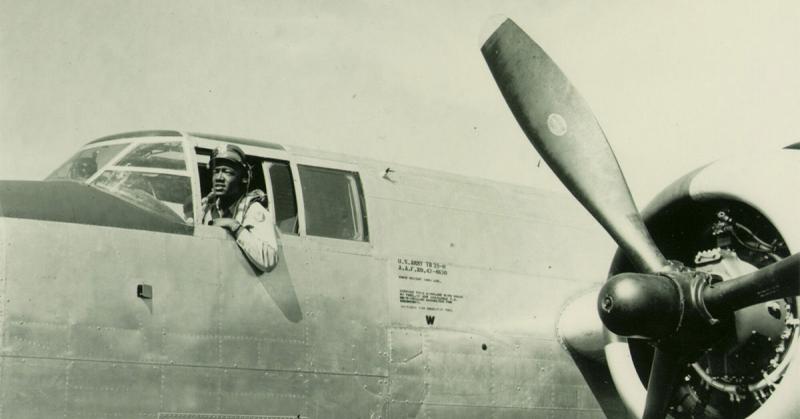
One of the most notable alumni of the University of Denver Graduate School of Social Work (GSSW) is a man many at GSSW have not heard of: Lt. Col. John W. Mosley, Jr. (MSW ’49).
Mosley attended Colorado State College of Agriculture and Mechanic Arts (now named Colorado State University), where he was an undefeated wrestler, the first Black football player since 1906, and the first Black player to letter in football. He also was an honor student and sang in school theatrical productions. Of note, Mosley was among the nation’s first Black bomber pilots, serving with the Tuskegee Airmen before embarking on a long and distinguished military and civil service career.
Born in Denver, Colorado, in 1921, Mosley was the son of a Pullman porter from Missouri whose parents had been enslaved. His parents met and married in Denver; Mosley was their fourth child. He attended Whittier Elementary School, Cole Junior High, and Manual High Training High School, where he was valedictorian and a National Merit Scholar. He used his National Merit Scholarship to attend Colorado State College in 1939. As one of only nine African American students enrolled at that time, he was not allowed to live on campus because he was Black. Despite multiple barriers due to his race, he was ultimately elected class vice president in his junior and senior years.
Mosley had hoped to become the college’s first Black student in advanced ROTC, but he did not pass his required physical. He ultimately paid for an external medical evaluation, which he easily passed. He paid for his own flight lessons and earned his private pilot’s license with the Civilian Pilot Training Program. He hoped to be drafted into the new all-Black 99th Fighter Squadron, also known as the Tuskegee Airmen. However, racism persisted, and he was assigned to a segregated Army artillery unit in Fort Sill, Oklahoma. Disappointed, he and his family launched a letter-writing campaign highlighting his flight skills, character, and determination, and he finally received an assignment to Tuskegee, Alabama, to train as a bomber pilot. Mosely recalled, “I had to fight in order to fight!”
Segregated officer clubs and growing racial tensions within the military prompted Mosley, who personally witnessed the aftermath, to write President Harry S. Truman about integrating the Armed Forces. Mosley felt his efforts helped to break down racial barriers in the nation’s newly formed Air Force in 1947.
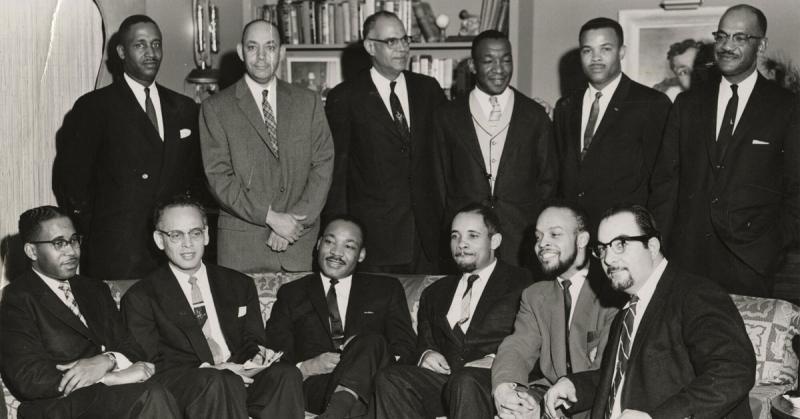
Greensboro, North Carolina, community members and John W. Mosley (back row, 4th from left) pose for a photo with Martin Luther King, Jr. (seated at center), after King’s speech at Bennet College in 1958. Source: Denver Public Library Special Collections
The Tuskegee Airmen flew 15,000 missions in World War II and helped to pave the way for integration of the U.S. Armed Forces. Following his World War II service, Mosley enrolled in GSSW in 1948. After graduating with his MSW the following year, he worked as a YMCA youth director in Kansas City, Missouri, where he created the “Swoop Club” focused on fostering young people’s interest in aviation and science. Upon his return to Denver, he founded the Denver Chapter of the Tuskegee Airmen.
Mosley was called back to active duty in 1951 and served in the Korean and Vietnam conflicts. His service resulted in his family living throughout Europe. Upon their return to the United States, Mosley became an assistant professor of air science at North Carolina A&T University. In 1959, they relocated to Pasadena, California, and he became the director of operations and training for the U.S. Air Force Reserve Officer Training Center. In 1962, while stationed at Lackland Air Force Base in Texas, Mosley served as director of operations and curricula for the 327th Technical Training School. He was then assigned to Colorado’s Lowry Air Force Base in 1965, serving as chief of instructional systems development for the 3415th Technical Training School. From 1966 to 1967 during the Vietnam War, Mosley was stationed in Thailand, where he was chief of combat operations, plans, and analysis for the 388th Tactical Fighting Wing. He then returned to Lowry as director of operations and training for the Rocky Mountain Region U.S. Air Force Civil Air Patrol.
Mosley retired as a lieutenant colonel from the U.S. Air Force 1970. After retirement from military service, during the Nixon administration, he was special assistant to the civil rights activist James Farmer, Secretary for the Administration of Health, Education and Welfare. Mosley also served as an equal opportunity specialist for the Office of Civil Rights and worked as a staff officer for the U.S. Department of Health and Human Services.
Mosley was inducted into Colorado State University (CSU) Sports Hall of Fame in 1998, and he received an honorary Doctor of Humane Letters from CSU in 2004. CSU’s Lt. Col. John Mosley Leadership Program is named in his honor. In 2007, Mosley and other Tuskegee Airmen received the Congressional Gold Medal from President George W. Bush, and in 2009, Mosley was inducted into the Colorado Sports Hall of Fame. In 2024, CSU retired Mosley’s #14 for all its sports teams.
Mosley married his high school sweetheart, Edna (Wilson) Mosley, on January 12, 1945, and they subsequently had four children. She was an icon in her own right: She was the first African American to serve on the Aurora, Colorado, City Council and was a founding member of the Women’s Bank, which supported women’s financial freedom. She received an honorary doctorate from CSU in 1988.
Throughout their lives, the couple remained active in issues such as veterans affairs, housing, and gender and racial equality. They created the Denver Foundation’s John W. and Edna Wilson Mosley Scholarship to help African American students from Aurora, Denver, and Cherry Creek public schools with the cost of their first year of accredited post-secondary education. An Aurora elementary school, The Edna and John W. Mosley P-8 School, was named in their honor.
Mosley died May 22, 2015, at the age of 93. In 2021, Congress passed a bill to rename the Veterans Affairs community-based outpatient clinic in Aurora after Mosley. President Joe Biden signed the act into law in November 2021.The ribbon cutting was held January 27, 2025, and the doors opened a week later.
Colorado Rep. Jason Crow introduced the legislation, saying, “Lieutenant Colonel Mosley embodies the finest our country has to offer. He was an inspirational leader in the Aurora community and in the Air Force. Naming the new Aurora clinic after Colonel Mosley honors his legacy and will inspire future generations to break barriers … I can’t think of a better name for my fellow veterans to walk into this new clinic in Aurora, CO, than to see the name of Colonel John Mosley as they walk in and to remember his service, his sacrifice, his leadership, and the best of what we can be as a country.”