Understanding School Safety
Author(s)
GSSW
Communication Team
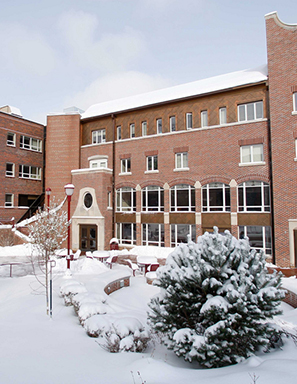
GSSW Prof. Mónica Gutiérrez is studying the influences on school safety for Latine and Black high schoolers
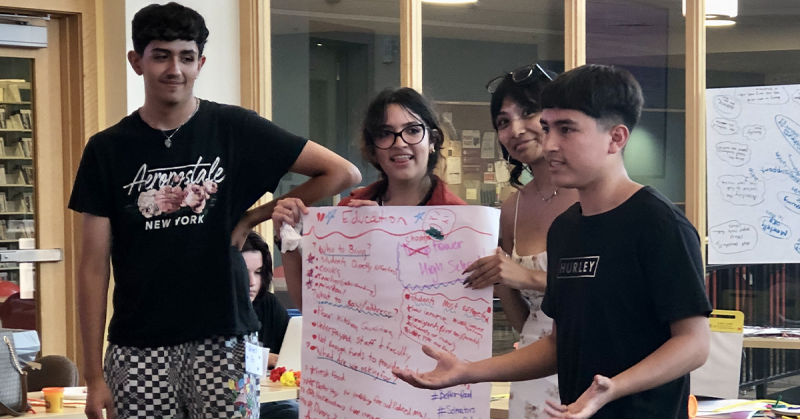
Denver Public Schools high school students participate in the 2023 Youth Liberation Camp, which was co-sponsored by GSSW with logistics support from Prof. Mónica Gutiérrez. Participants were deeply invested in transforming the school system to be more just and equitable.
In the wake of widespread protests of the police killing of George Floyd in 2020, the Denver Public Schools (DPS) board voted unanimously to end the district’s contract with the Denver Police Department and phase school resource officers (SROs) out of Denver schools. However, following a shooting inside East High School, in 2023 the board voted to bring SROs back.
That unusual policy reversal intrigued University of Denver Graduate School of Social Work (GSSW) Assistant Professor Mónica Gutiérrez, who notes that very few school districts in the nation have removed SROs only to subsequently reintroduce them. Gutiérrez wondered how SROs influence Latine and Black high school students’ experiences of policing and structural and institutional conditions of belonging in school.
In partnership with DPS students, families, staff, and administrators, Gutiérrez is using a QuantCrit approach (that is, applying critical race theory to quantitative data) to explore the role of SROs in Denver Public Schools. The mixed-methods study includes analysis of archival policy records and administrative data on disciplinary practices and data from focus groups conducted with students, families, teachers, front-office staff, and maintenance and cafeteria staff from four DPS high schools. Schools were invited to participate based on study criteria indicating that they reflect sites where the relationship between safety practices, student experiences, and racialized discipline can be meaningfully examined.
The project, Safety Beyond Surveillance, is funded by a DU PROF Grant and the University’s Latinx Center. Gutiérrez explains that the project’s research team is supported by a transdisciplinary advisory group, including Morgridge College of Education Professor Maria Salazar and Department of Sociology & Criminology Professor Hava Gordon. Academic collaborators include Rutgers Graduate School of Applied and Professional Psychology Assistant Professor Kamilah Legette and Tom Romero, a professor at the University of Nevada, Las Vegas, Boyd School of Law. Gutiérrez says, “Their expertise in education, sociology, law, school discipline, behavioral health, and racial inequities in public education has strengthened the project’s ability to examine school safety from multiple perspectives and to ground the work in both rigorous scholarship and community relevance.”
Gutiérrez’s community-engaged research prioritizes relationship-building, reciprocity, and shared ownership of the research process. For the SRO project, focus groups are conducted as pláticas, which she explains are an organic, dialogue-centered interview method rooted in everyday conversation and cultural practice. The groups begin by drawing maps of what they consider to be “safe spaces” in schools: the places they would go if violence occurred. Gutiérrez will then compare those maps to what the school considers safe spaces to see where the understanding of safety converges or diverges. Although data collection is still underway, Gutiérrez can already see a gap between how the district defines “safety” and how students experience it.
For example, federal school safety policy shapes how DPS operationalizes school safety, prioritizing hardened infrastructure such as classrooms designated for shelter-in-place protocols. However, Latine and Black students may experience everything from microaggressions to disproportionate discipline to physical violence in school, and they and their families express that no place is safe. Gutiérrez says participants also express a fear of immigration actions.
She adds that students emphasize who is safe, not where is safe — safe people versus safe places. “There are certain places, like the cafeteria, which are deemed safe, but only because of staff that work there.” That is why Gutiérrez has included maintenance and cafeteria staff in her research. She explains that such support staff often share racial and ethnic identities with students, speak their language, and understand their culture. “When we think about school safety from a public perspective, we don’t include them, but they are cultural touchpoints for students.”