Advancing LGBTQIA+ Research

Back to Article Listing

Author(s)

GSSW

Communication Team

Craig Hall
Communication Team"

gssw.communications@du.edu

PhD alumni Brendon Holloway and Brittanie Ash are continuing Eugene Walls’ research legacy
Profile  •
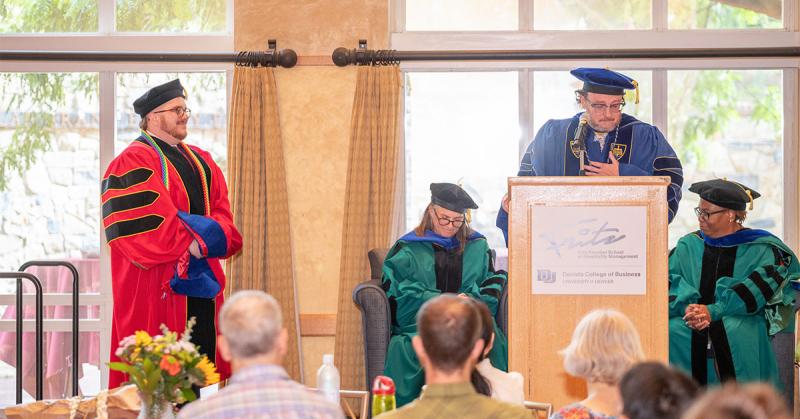
Brendon Holloway PhD Hooding Ceremony and Eugene Walls on the stand

Professor Eugene Walls (center) speaks about graduating PhD student Brendon Holloway (left) at Holloway's hooding ceremony.

University of Denver Graduate School of Social Work (GSSW) Professor Eugene Walls retired in summer 2025, but two of his former GSSW doctoral students, Brittanie Ash (PhD ’20) and Brendon Holloway (PhD ’25), will continue his research legacy into the future.

Ash and Holloway have assumed leadership of the LGBQT/NB (lesbian, gay, bisexual, transgender, queer and nonbinary) Research Team, which Walls founded in 2012 to foster connection and collaboration among scholars. The team is now hosted at the Colorado State University (CSU) School of Social Work, where Ash and Holloway are assistant professors. However, they say the team’s core mission will continue.

Ash says, “Being a queer and trans academic can be somewhat isolating if you don’t have coworkers who share your identity. The research team is a community-led space where we can all be around each other and unmask and talk about how it’s going. It really is a space for academic connection, community — a place for scholarship to grow and thrive.”

She adds, “There’s something really special when you get a group of people together who share identities and are doing research related to those identities. It provides freedom to be exactly who you are, learn from someone who is exactly who they are and do research about a community you are both part of and care deeply about.”

The 45-member group includes junior and senior faculty from across the nation and provides support and informal mentorship for doctoral students. The group also helps develop future social work doctoral students, who can join the group as master’s-level scholars.

Holloway adds, “A lot of what Eugene has built will stay in place. We’ll continue regular meetings, creating a community space, uplifting the papers that come out of this group, and connecting newer scholars to mentoring and collaborators.” Holloway and Ash also hope to create a more formal presence for group. Holloway says, “We want the world to see that we exist as a research team and make sure the work we’re doing has a place to go where it can impact queer and trans lives.”
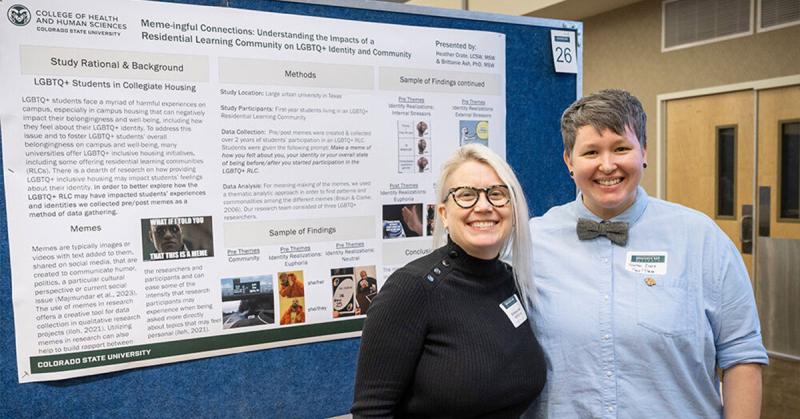
 

Brittany Ash

GSSW alumna and CSU assistant professor Brittanie Ash with CSU doctoral student Heather Crate.

Promoting Social Justice in Social Work Education

After graduating from GSSW, Ash spent three years at the University of Texas at Arlington (UTA). She is now in her third year at CSU. Broadly, Ash’s research focuses on understanding how best to support and build inclusive and affirming environments for LGBTQ+ people and communities. She also applies an intersectional lens to deepen understanding of risk and resilience among people with marginalized identities.

In addition, Ash focuses on promoting social justice and inclusion within social work classroom experiences and identifies strategies for educators to more fully integrate a critical social justice lens into pedagogy. Her dissertation, “Social Work, Social Justice, and the Causes to Which We Are Called: Attitudes, Ally Behavior, and Activism,” reviewed how schools of social work deliver on their social justice promise (social justice is a core value of the social work profession).

More recently, Ash collected qualitative, quantitative and arts-based data from LGBTQ+ students in a UTA residential learning community. The participants created memes at the beginning and end of the study period. Ash notes that when analyzed, the memes were comparable with interview data. As detailed in a forthcoming paper in the Journal of College and University Student Housing, students in the residential learning community felt better about their LGBTQ+ identity and had lower anxiety and depression than students in a comparison group (read more about the project in the Journal of LGBT Youth). Ash is now writing a methods paper about using memes in qualitative research.

Ash has also collaborated with Walls and Holloway on activism-related research, exploring what causes people to become advocates and allies for queer and trans people. She is also looking at how geospatial precinct-level voting might map onto well-being. Her goal is to determine whether LTBTQ+ young people in conservative areas experience more depression and suicidality, among other outcomes.

In addition, Ash is reviewing syllabi from BSW- and MSW-level social work practice courses nationwide to determine how much the courses prepare students with social work practice skills for LBTBQ+ clients. Finally, using funding from the Bohemian Foundation, she will conduct research with gender and sexuality alliances in a local school district, focusing on internal issues such as coping skills as well as external skills, such as levels of activism.

Understanding Gender Euphoria

Holloway is starting their first faculty appointment at CSU, where they will teach a course on macro social work and another on intersectionality and identity. Holloway and Walls co-developed GSSW’s course on Social Work Practice with LGBTQIA Communities, which centers joy, resistance and intersectionality. Holloway intends to bring that perspective to CSU by working with the school’s LGBTQ course lead to revamp the course and incorporate “a more balanced view of trans communities that’s not rooted in deficit.”

At GSSW, Holloway’s three-paper dissertation, “The Embodiment and Experiences of Gender Euphoria among Transgender and Nonbinary Communities: A Mixed-Methods Inquiry,” included a scoping review of the literature on how gender euphoria is described and experienced. Holloway also conducted an arts-based qualitative study with 22 trans participants, who met in two 6-week creative writing groups. Holloway provided writing prompts related to gender euphoria, aiming to capture how trans people describe, experience and embody gender euphoria. In addition, the project included a quantitative analysis of data from Colorado’s 2022 Trans Health Survey, which included questions about gender euphoria.

Holloway notes, “There were threads throughout the papers, such as how beneficial gender euphoria is in terms of mental health and health benefits, and the importance of trans community. Feeling connection to trans community was a catalyst for gender euphoria.” Holloway says their findings also demonstrate the importance of intercommunity support: finding community with other trans people who share racial, ethnic, or other aspects of identity, including neurodivergence and body size. “If they found other community members who looked like them, that was a facilitator for gender euphoria.”

Holloway plans to continue exploring gender euphoria as a form of health promotion for trans communities. They have funding to continue the writing groups and hope to host groups devoted to neurodivergent trans people. They also plan to partner with a Black trans group facilitator to expand the intersectional perspective, as much of the gender euphoria literature thus far has been focused on white trans people.

Ash and Holloway also have funding to continue the Colorado Trans Health Survey in 2027. Across their work, Ash and Holloway say they hope to honor and build on Walls’ legacy as a scholar, teacher and mentor.

cta

GSSW’s social work PhD Program prepares students to drive social change through education and research.

Learn More