Cultivating Community Connections
Author(s)
GSSW
Communication Team
Board of Advisors Vice Chair Richard Lewis supports BIPOC-led and BIPOC-serving nonprofit organizations
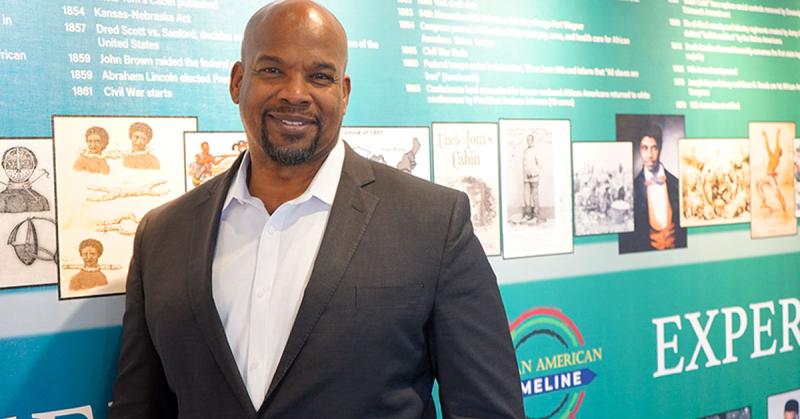
University of Denver Graduate School of Social Work (GSSW) Board of Advisors Vice Chair Richard Lewis values creating connections. As founder and CEO of technology firm RTL Networks Inc., Lewis’s collaborative leadership style led the technology firm to become one of the nation’s fastest growing privately owned companies and one of the largest Black-owned businesses in the country.
In an interview with the Boettcher Foundation, Lewis recalled, “The first leaders I had the opportunity to meet and get to know were my parents, and in particular my mother who raised my brother and me. My mom was brilliant and forceful, but very collaborative. Because it was just the three of us, she impressed upon us that we would have to work together to succeed as a family unit. This always stuck with me and to this day, I feel that one of the strongest pillars of my leadership style is to foster collaboration whenever and wherever possible, as we are able to accomplish more together than alone.”
That emphasis on collaboration was further cultivated at the U.S. Air Force Academy, where Lewis earned a computer science degree before embarking on a 10-year career as an Air Force communications officer. He received his honorable discharge from the U. S. Air Force at the rank of captain after serving his country in numerous domestic and international assignments. He then earned an MBA and a master’s degree in computer science and security systems, followed by a tour working in corporate America. There, Lewis says, “I began to prioritize understanding customer needs, delivering high-quality products and services, and maintaining strong customer relationships.”
In a 2024 interview with the Denver Weekly News, Lewis recalled, “It was a tough economic climate, and after being laid off twice, I had enough … I joined corporate for stability. After the second layoff, I figured I could be unstable on my own, so I created RTL Networks in 2002.”
Although RTL Networks had a humble start in a basement office, it now employs more than 200 people in 19 states and has provided IT services to federal civilian agencies and the Department of Defense for more than two decades.
In 2022, 20 years after starting RTL Networks, Lewis made another bold move: establishing the nonprofit RTL Foundation to empower historically underserved communities by providing education and support in technology, history, and entrepreneurship.
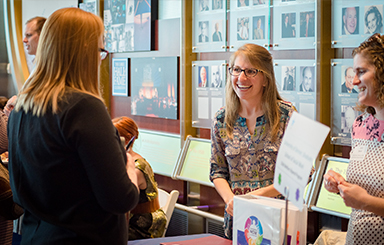
One of the foundation’s signature programs is the BIPOC Nonprofit Development Center (BNDC), which aims to address systemic inequities by creating a more inclusive and supportive environment for minority-led organizations. As the nation’s first incubator exclusively focused on fostering the growth and sustainability of BIPOC-led and BIPOC-serving nonprofit organizations, the BNDC leverages the foundation’s resources and Lewis’s many business and civic connections, providing mentorship, programming, a collaborative workspace, and enhanced operational capacity for 17 nonprofits that together serve almost 200,000 Coloradans.
Lewis explains, “In addition to connecting these organizations to the communities they serve, the BNDC also connects community-serving organizations to each other. There are collisions and connections happening amongst our members that we couldn’t have planned for. It’s magical to watch.”