Empowering Historically Underserved Communities
Author(s)
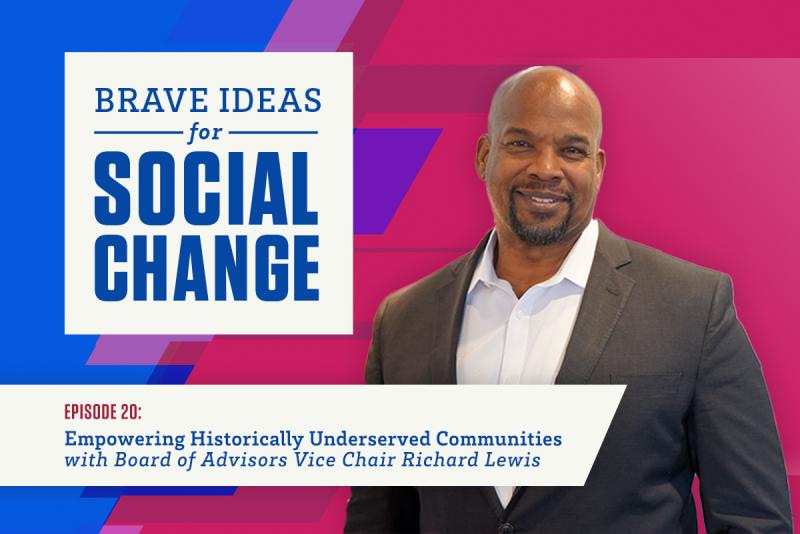
Brave Idea: University of Denver Graduate School of Social Work Board of Advisors Vice Chair Richard Lewis is founder and CEO of RTL Networks Inc., which has provided IT services to federal civilian agencies and the Department of Defense for over 20 years. He is also the founder and board chair of the RTL Foundation, which empowers historically underserved communities by providing education and support in technology, history, and entrepreneurship. Richard has long been committed to forging new partnerships and connections between cultural and higher education institutions and individuals and organizations in the communities they serve. He talks about his efforts to support BIPOC-led and BIPOC-serving organizations and discusses ways that schools of social work can partner to better support underserved communities.
Resources:
Richard Lewis—Preserving History, Building Futures [podcast]
Pioneering Support for Colorado’s BIPOC Nonprofits
Rich Lewis: Uniting People, Community, and Technology
Black History Month Feature: RTL Networks
Black History Month Isn’t Limited to February on Richard Lewis’s Calendar
Impact Aurora: Richard Lewis, President and CEO of RTL Networks [video]
Boots to Suits Supports Veteran and Military Students
From “Boots to Suits,” Transitioning From Military Service to Civilian Life [video]
Transcript:
Dean McCoy:
Hello, I’m Professor Henrika McCoy. I am dean of the Graduate School of Social Work at the University of Denver. Welcome to the latest episode of our Brave Ideas for Social Change podcast series. We typically draw on GSSW expertise for fast-moving discussions on engaging research practice and policy innovations that will spur social change. But today we’re taking a different spin, and we have as our guest, our GSSW Board of Advisors Vice Chair Richard Lewis, who is founder and CEO of RTL Networks, which has successfully provided IT services to federal civilian agencies in the Department of Defense for over 20 years. He’s also the founder and board chair of the RTL Foundation, which empowers historically underserved communities by providing education and support and technology, history, and entrepreneurship. Richard has also been committed to forging new partnerships and connections between cultural and higher education institutions and individuals and organizations in the communities they serve. So Richard, you and I met initially about a year ago when you were hosting the launch of the 2024 Colorado Black Health Resource Directory. It was here in this space, and in our brief conversation, your commitment to underserved and ignored communities was quite apparent. So as social workers, it’s always refreshing to know that we’re not alone in our efforts to partner with others to effect change. So Richard, I want to thank you for sharing your perspective with us today, and I’m thrilled to have this conversation with you.
Richard Lewis:
Happy to be here. Thank you.
Dean McCoy:
You’re welcome.
So, you have more than 30 years of military and corporate leadership experience and have achieved many accomplishments throughout your career. Let’s start by telling our listeners a bit more about RTL Networks, some of the achievements you’re most proud of and how you got to where you are today.
Richard Lewis:
Thank you, Henrika. Sure, I’m happy to be here. Good morning everybody. Or good day. RTL networks. 24 years old this year—That’s a long time.
Dean McCoy:
You don’t look it.
Richard Lewis:
Oh, you’re very kind. I guess some of the achievement is just being here. We’ve seen just about everything you can see in terms of business cycles, ups and downs, things that are great, things that are not so great, and the fact that we’re still here is wonderful. And along the way, in addition to some of the accolades such as being Inc 500 and some of the Black enterprise Top 100 lists and things of that nature, I think we’re really proud of the work we’ve done in the community, because it is one thing to have a successful business, but it’s another thing if you’re only focused on that, I think you miss an opportunity to make a difference. And that’s what we are doing at RTL Networks. My journey actually, and getting to where I am both in business and with the nonprofit, it didn’t happen all overnight.
It’s a journey, right? I went to the Air Force Academy, struggled to get through there, spent 10 years in the military, amazing experience. I know a lot of people are down on the military, but I found it to be an amazing experience where I learned a lot and gained a lot of knowledge about how things work, how the world works, technology in my field. I had a lot of responsibility. I did a quick stretch in corporate America. That was a tough transition going from the military to corporate America. I had no experience in corporate America. I didn’t know what to expect. In the military, you don’t have salespeople, you don’t have marketing people. So I was meeting salespeople for the first time in my life going into corporate America. I was meeting marketing and HR people for the first time in my life going into corporate America.
I needed to learn quickly what they did and how their work integrated with work that I was expected to do. So it was quite a learning experience, and my eyes were like saucers open wide, and I was taking notes on folks. What do you do here? What do you do in this part of the organization? What is your function? How does everything tie together? It was like a mini MBA really for the first time learning this. What I came to learn is … that going into corporate America in that way, I ended up knowing corporate America better than a lot of people who had been there for a long time because a lot of people just learned through proximity and really never understood at a deep level how these other organizations function. And I know that I have to submit my paperwork, but I don’t know what happens to it after I submit it. And those were all the things I was really working to figure out, and I think that really helped me as an entrepreneur. So we’re really trying to impart some of that deeper understanding of how things work to our members here at the BIPOC Nonprofit Development Center.
Dean McCoy:
Okay, so all those skills together, your military experience, your stretch in corporate America, you were an athlete, right?
Richard Lewis:
I was an athlete.
Dean McCoy:
And how does that help?
Richard Lewis:
Oh, you learn that you don’t get strong overnight. Everyone thinks that. I think this generation gets a hard rap, but so it’s not just [generational]. There have always been people who thought that if I just really push hard for a day or two, I can get there. When you’re in the weight room or trying to get faster or trying to learn a technique, you learn very quickly in sports that a day or two is not going to increase my bench or my squat or anything like that. So it takes time, it takes consistency, it takes hard work.
Dean McCoy:
So what I hear from you, perhaps for all of us to learn is that all the experiences that you have culminate into where you sit today, and so there’s value in everything, even the things that feel hard, that there’s a learning opportunity in all of them, and then you figure out how do you put those things together to take the next step?
Richard Lewis:
I think that’s true for all of us, right? I mean, we are all just a conglomeration of our activities. And I will add to that one of the most important things that makes us into who we are is our failures.
Dean McCoy:
I would agree.
Richard Lewis:
Don’t be afraid to try and exert yourself and extend yourself. And if you fail, it’s only a failure if you stop there.
Dean McCoy:
So we are recording today from the RTL Foundation podcast studio. This is one of two with a resource available to members of the community. So please tell us more about the foundation, what it does, and then your inspiration for creating the foundation.
Richard Lewis:
Sure. So the mission of the foundation is to provide and support educational opportunities in the areas of entrepreneurship, history, and technology. We’re very excited about the work happening in the BIPOC Nonprofit Development Center, the BNDC. The BNDC is a response to the entrepreneurship pillar that we have at the foundation. So nonprofits are entrepreneurs. A lot of people don’t make that connection, whereas a for-profit founder wants to make a million bucks or whatever. A nonprofit entrepreneur really just wants to create a stable organization that serves the community in a consistent manner.
Our nonprofits that are here are entrepreneurs, and we are serving them by providing deeply discounted memberships. And that membership includes the office space and the trainings we put together. We partnered with the United Way Social Venture Partners and other organizations to bring training in the areas of board development, governance, fundraising, and other facets of nonprofits. We’ve partnered with these organizations to provide that training to our members to increase their business acumen, and then the collaboration that they are experiencing is working together. A lot of people, the collaboration has been phenomenal. A lot of smaller organizations are looking up to the larger organizations saying, you have three employees. We’re looking to hire a first employee. Can you help me? I have questions. And we have some organizations that have programs where they have interns that are looking for work, and we have some organizations that have work and are looking for interns
And they’re collaborating. There are just so many collaborations that are happening just because these organizations are together and having the opportunity to get to know each other, like each other, trust each other, and now they’re working together. That is priceless. Being an entrepreneur of any kind is so often it's a very isolating feeling.
So they’re no longer isolated in this space. They’re with other like-minded community-serving organizations, and they’re learning a lot from each other in addition to the formal training that we provide.
Dean McCoy:
So I know you mentioned there are 17 current organizations.
Richard Lewis:
Correct.
Dean McCoy:
How did they find you and what is your capacity?
Richard Lewis:
We have, like I said, we have 11 offices and 18 cubicles. So depending on the size of the cohort organizations, we call ’em cohorts, we bring organizations in. We’re an incubator versus a coworking space, so they can only stay for two to three years or so, depending on what the break points are. And they find out about us through word of mouth and through social media.
Dean McCoy:
So I know that this is located here in Denver, correct? I also know that your company has a national presence. And I also know that you’ve indicated that you did this because you realized it didn’t exist anywhere else. Have you thought about trying to replicate this, expand … You’ve got physical locations of your company and other places like DC, you have some international presence in Colombia. So have you thought about doing this somewhere else?
Richard Lewis:
I think the need across the nation is strong. We’re going to focus on Denver right now, where we’re happily and strategically located, where we’re happily and intentionally located here in Five Points, Colorado--downtown. We’re going to focus on getting it right here. And maybe that’s a conversation we can have on how we can open in other metro areas. A lot of our members, most of the members in our space didn’t have physical office space prior to coming here. And so any city you go into where all of your organizations such as the NAACP or other very strong and necessary organizations are just boxes on their website because they don’t have space. So if you don’t have physical space, it’s really, it’s a headwind to any change you’re trying to affect.
Dean McCoy:
Do you think that in our current time where we emerged out of COVID, people working at home, some people have continued to work at home, some people have now come back to the offices. Have you found any challenges with getting people to understand the importance of space? I think space is important. I think sharing, there are great times to work at home. I love to work at home. I get a lot done at home, but I’m not an entrepreneur starting a nonprofit. So do you think that people really do understand the value if you’re doing that kind of work of why having people around you, even if they’re not in the same kind of enterprise or understand the value of sharing space?
Richard Lewis:
Absolutely. We’ve definitely seen the impact of COVID in terms of office space and people actually coming into the office, not just here, but across the city, across the country. There is a certain magic that happens in offices, especially when you’re building something. It doesn’t mean you have to be here all the time, and that’s a conversation for individual organizations to make. But for nonprofits, if you have funders, where are you going to bring your funders if you want them to see your work, if you have employees or even the organizations you support or the people, the communities you support. If you don’t have space, where are you going to actually bring those people? Sometimes when I am doing my last end-of-day walkthroughs, sometimes we have organizations here doing late events, and some of these events just give me goosebumps. I walk through the organization as I leave the office, it’ll be six, seven o’clock or something like that. And I’ll notice that one of the conference rooms or event spaces is full, and I’ll just walk by to see what’s going on and the lights are dim. There’s a movie going on on home ownership, and there are families there who are clearly finishing work. They’ve got the baby in the arms and they’re watching these videos on how to get into a property, how to purchase a home, first-time homebuyer programs and things of that nature. I get tingles because I know someone’s life is changing tonight. These organizations are [doing] amazing work, and it’s important, and space is a big part of what makes that allowable. Where would they be at seven o’clock at night with these many people from the community if they did not have their own space? You’re not going to do that at Starbucks, and you’re not going to do that in the basement of your own home. It’s so important to have space for so many reasons, and we’re happy to support our organizations in that way.
Dean McCoy:
And could you just say a little bit about the expanse of the type of nonprofits that are here? What do they cover? What are they focused on?
Richard Lewis:
It’s a broad variety of organizations that are here. We have everything from frontline farming, which teaches people of color how to farm. Farming used to be a very big part of the African American business. A lot of entrepreneurs in the farming space. Not so much today for a number of reasons, but they are reintroducing that career field and parts of it to different parts of the community. So that’s amazing. So we have everything from frontline farming to Colorado Black Women for Political Action to Latin American Education Foundation, a number of organizations that service different sectors and different needs—housing, health—it is pretty phenomenal. They’re all getting to know each other, trust each other, and they’re collaborating.
Dean McCoy:
That’s amazing. Well, you bring up history, and I know that one of the foundation’s initiatives has been the African American Experience Timeline. So we were really pleased at GSSW to install the timeline a little bit over a year ago, or almost a year ago. And it provides everyone who walks by an education [that] sparks meaningful conversation. So the first thing I do when I walk in the building when I’m there is to turn the spotlight on our first floor. It’s almost the first thing you see when you walk in. We’ve got spotlights there, and that’s the first thing I do. And I’m always thrilled when I come in and someone beat me to the punch. Because you cannot avoid looking at it because it’s right by our elevator. It’s on our way to the library. It’s in a really prominent space. It really ensures that the full history of African Americans in the country who’ve been historically marginalized and oppressed are really understood and seen as fully realized people. And it reminds us that as African- Americans we’re resilient, we’re successful, that we shouldn’t be solely defined by the tragedies that have befallen us throughout the world. And for me, it’s heartwarming. I mean, we sit here in Black History Month purposely, and as we see our history being consistently erased across the country on a daily basis. Why don’t you tell us a little bit about how this project came about, what drove you to do it, what role it currently serves, and kind of what your thinking is about how it should continue as we progress in our future, I guess?
Richard Lewis:
Sure, sure. You just kind of said it as our history is being manipulated and changed and deleted and watered down. That speaks to why it’s so important. But lemme go back and say some of the other reasons why it’s important and how it started. When I went through Leadership Denver in 2006, there was a day of that program specifically dedicated the conversation of race. And during that day, I was tasked with leading a conversation on the African American experience. Tough conversation to have with a mixed company. I mean, if you just want to have a light conversation and breeze through it, why can’t we all just get along then? No feathers are ruffled. It’s an easy conversation; you get through the day. But the group we had was really focused on having a meaningful conversation and challenging people, their ideas, their beliefs, and what they know and think they know. And we were wondering, how do we do that without setting the room on fire, right? Because that’s a conversation that often people either get aggressive, people get defensive, most people just get turned off. So how do we tastefully have this conversation? And we thought about a number of things we needed to talk about. We need to talk about this. We need to talk about this event. And this led to that. And eventually we had about 50 or 60 data points that we thought were important to talk about in this conversation.
And we were like, well, is that helpful? I mean, all these things … it was hard enough just having the conversation now, 50 things to talk about. But we ended up putting dates on them and kind of organizing it. So intuitive, a timeline. It was already kind of in chronological order anyway. And wow, it was so amazing When it was a room full of leaders, we took that timeline and presented it to them, and people didn’t feel attacked. They just saw it as information. It was a room full of leaders. And when they receive information, what do they want to do? They want to digest it, understand it. And we saw that happening real time. And the response was very positive. There were a lot of a-has, there were a lot of, “oh, I didn’t know where that came from.” And what we were really excited by was the fact that those a-has were not just coming from White America, they were coming from African Americans as well. We clearly don’t all necessarily understand and know our own history. So that’s why it was so important. We don’t understand it, which makes us vulnerable to change.
And the conversation was so positive that I’ve just never been able to forget it. So since 2006, I’ve been adding to the timeline and adding pictures, adding data points, created a website, AfricanAmericantimeline.org. And on that website you can actually order the timeline. You can order it, you can put the dimensions of a wall up and it’ll produce a Fathead kind of situation where you can just stick it on the walls or you can order it from two feet to nine feet in different mediums like acrylic or brushed aluminum or roll paper. So [I’m] really excited about the timeline and where it’s going. As a matter of fact, we’re currently working on putting together a BIPOC timeline focused strictly on the state of Colorado.
Dean McCoy:
So what’s the process for that? Is it the same gathering a group of people together? Is it you’re taking on this task amongst all the other things that you’re doing? What will that look like?
Richard Lewis:
It’s already started, and what does it look like? It’s a lot of me, but it’s also reaching out to other organizations and other spaces to validate my data points and artists who will take what I’ve done and make it more scalable, more refined.
Dean McCoy:
You often host people here. You have an art space, and I’ve had the privilege of being able to attend one of those events. Why don’t you tell us a little bit about that? I came in August, I saw Dwayne Glapion in August. Fantastic. So why don’t you tell us more about kind of the art space since you’ve already led into that.
Richard Lewis:
Sure, sure. A lot of people ask, why would you put art here? And if you think about it, art is one of the ways that we get to know each other. Where do we commune most often? Well, food, we get together for a meal, we’ll talk and get to know each other. Music, same thing. Music is how we all come together. And art. So having the art gallery here at the RTL Foundation is doing that exactly that for us. And additionally, a lot of BIPOC artists have a difficult time getting into galleries. We’re not connected to galleries. We don’t have a lot of those connections. So by putting an art gallery in the RTL Foundation space, and the space doubles as an event center, we’re able to showcase some of the amazing talent in our communities. And you got to see Dwayne. We just had Darrell Anderson in our space, and it was really amazing. We had Brian Leach from Ibotta come through, and he immediately was connected to one of Darrell’s pieces and ended up buying it. Wow.
Dean McCoy:
That’s great.
Richard Lewis:
So that piece now hangs in Brian’s office, and next month, Women’s History Month, March, we’re collaborating with the Women’s Hall of Fame, the Colorado Women’s Hall of Fame, and we’re going to do a BIPOC selection of their amazing portrait gallery and have it here in our space for the month of March.
Dean McCoy:
That’s wonderful … are there other things planned?
Richard Lewis:
Yes, we have multiple events planned throughout the year. But again, art is just a way that we can do an event. We can have an artist, we’ll have a meet-the-artist event, we’ll invite the community to come and meet the artist. But at the same time, we’re exposing other people to the work we do.
Dean McCoy:
So how do people learn about those events that they’re interested in attending?
Richard Lewis:
It's word of mouth and through social media.
Dean McCoy:
So they need to follow you on LinkedIn or Facebook or …
Richard Lewis:
… Instagram. You got it. You got it. Please follow us on social media for those events.
Dean McCoy:
Okay. So as a successful corporate leader, what do you see as the benefit of diversity, equity, [and] inclusion initiatives in the business sector? We are seeing certainly a change in our broader society. It has certainly impacted higher education in multiple ways. In terms of titles, in terms of access to funding, in terms of initiatives that we’re able to openly take on for fear, as you’ve seen, like many of our listeners have seen attacks on large institutions of higher education and what that means in terms of being able to continue to finance certain parts of their operation. I guess in the business sector, what do you see in terms of the government curtailing and how that might impact you and other people that you’re aware of?
Richard Lewis:
Sure, sure. Lots of changes going on there. It seems like we were making such progress, but I’m optimistic that some of the curtailing will actually work out well in the end. I mean, DEI was never intended, I don’t believe to be a bolt-on to businesses, because when it’s a bolt-on, it almost seems like an extra duty and extra cost. I think the organizations that really get it—and hopefully more will get it as we go along, see DEI, is something to bring into the core of the business, make it part of who your true identity is. And those organizations, I think, will have an advantage because diversity is important. If your organization can’t look at a situation from multiple angles and perspectives, you’re going to be limited in the marketplace. So I think the companies that really get it and make DEI a part of their core values are going to see an advantage in the marketplace anyway.
Dean McCoy:
I think that makes sense. I remember a number of years ago, I was speaking with students who were entering the job market for academia, and they were excited because they were seeing lots of positions that were being posted that were specifically focused on race or social justice, etcetera. And my comment to them was, that’s great, but I think that you want to make sure you look and determine, is this something new they’re doing because of a change in society, which is great. But what about the schools or experiences for places that have already been doing that, that has already been the core of their commitment. So it’s important to not just respond to reactivity. You want to make sure you respond in places where people really do have it as a core and do have it integrated, and not just because it’s the newest thing that they think will move them to the next step. And the minute the resources that come with it go away, that opportunity goes away, too. And so I think people do have to make sure they really understand what that message is.
Richard Lewis:
I agree with that. And the fact that DEI is under attack may drive that ultimate destination, if you will. We’ll get there sooner …
Dean McCoy:
Right? Yeah. So part of the reason why you agreed to do this with me, I believe, is because you are the vice chair of our new Graduate School of Social Work Board of Advisors, which we are very appreciative of. Part of our reason was the work that you do, your great reputation, the community, the in-depth knowledge that you have of Denver, of Colorado, of our larger, greater … I mean, your company has done work throughout the world. And so we were really pleased and thrilled that you’re willing to partner with us. So at GSSW, we really prioritize nurturing deeper and more meaningful relationships, not only with the school, but with the communities that we serve. I’m relatively new as our dean, as you know, and I believe strongly that schools of social work need to not just exist physically in a place, but be an integrated part of our community. And so tell us why you decided to join. How you think as a school of social work or other academic institutions really need to move forward, I think particularly in this time of attack on higher education. And what are ways that you think we can partner with individuals like you, organizations like the RTL Foundation, who are in the community really doing the work, but might also want support or connections or partnerships?
Richard Lewis:
Sure, absolutely. And big part of the reason why I decided to get involved is exactly as you just said. … You personally, when we met, I appreciate that you said that my commitment to the community was apparent. However, also I also saw in you your commitment to bringing the resources, and talent, and brand, if you will, of DU into the communities. As you mentioned, you were in our space, you came to us, you were demonstrating with your mere presence that you are looking to see DU outreach. You’re not putting a note on social media and waiting for people to come to you. You are in the community. I noticed that. I was impressed by that as well. And I wanted to support you.
Dean McCoy:
Thank you.
Richard Lewis:
And as you’ve shared with me more about what the school is doing and some of the amazing people and programs, now I want to support the school. And so I was happy to get on board. I looked for ways to collaborate. The organizations here in our BIPOC Nonprofit Development Center, your brothers and sisters in arms, you’re out there doing teaching and showing social work. And it’s the organizations that we have that are the men and women who are in the trenches actually delivering that. And I think that there are a number of ways to partner. Some I can kind of see right now they’re formulating, others will become more apparent in time, but it starts with our working together.
Dean McCoy:
I agree. So my last question is what would you share as a message for perhaps individuals that are thinking of starting a foundation but have not done that, or organizations that maybe are not here part of the incubator, but because they’re far away and need, I think, to be in a physical space, but have needs, what are the messages that you want to send to those types of individuals or groups about what they can do in their own space to really invest?
Richard Lewis:
Sure. Absolutely. Number one, I would say if you’re thinking about starting an organization, first thing I’d do is make sure there’s no one else already doing it. Because it’s great to start things, but it’s a lot of work. And if you could take that energy and apply it to someone else who already has the same focus as you, that might be more productive. And we’re not competing with one another necessarily. So I would first look to see if there’s anyone else already doing the work that I’m interested in and seeing if there’s a way to partner before starting my own. The second thing I would say is if you’re looking to take advantage of the resources we have here at the RTL Foundation, at the BIPOC Nonprofit Development Center, just again, connect with us on social media. We will announce more information about some of the virtual programs we’re putting together, and they're really good. Like I said, we’ve partnered with some really outstanding organizations as far as how to teach our organizations and provide trainings in areas of board development, governance, fundraising, accounting, a number of topics that are really important to our community-serving organizations. And our virtual platform will extend a lot of those trainings to the virtual field. And because we have space, even our virtual members will have access to our space on a lesser basis. You may not be a member, but there’ll be so many hours a month that you could actually come and work from our space or use our conference rooms or event spaces, things of nature.
Dean McCoy:
So you mentioned you use conference rooms, event space, so we’ve been fortunate to be able to use your conference space. We’re here. Just tell us a little bit more about the spaces that people can access that are in the community.
Richard Lewis:
… We have an 8,000-square-foot facility here, totally dedicated to supporting the community. We have 17 nonprofits working from our space. We have two conference rooms. We have an event space, 11 offices, 18 cubicles and day spaces for our soon-launched a virtual program so that they can come in and just use a hotel space for the day.
Dean McCoy:
Okay, great. Well, we could talk for hours. As you know, I could easily talk your ear off for hours. I want to thank you for making time and then sharing your experiences with me about the future, about the space today. Thank you. Of course, for what you do for GSSW. And thank you for your contributions to the community.
Richard Lewis:
My pleasure. Thanks for honoring me as a guest on your broadcast.
Dean McCoy:
Of course. So thank you for listening today. Please subscribe to our Brave Ideas for Social Change podcasts. For more conversations like this one. Find links and resources related to this episode at socialwork.du.edu/change.