A Social Worker on City Council
Author(s)
GSSW
Communication Team
GSSW alumna Alli Jackson centers community as a new at-large representative on Aurora City Council
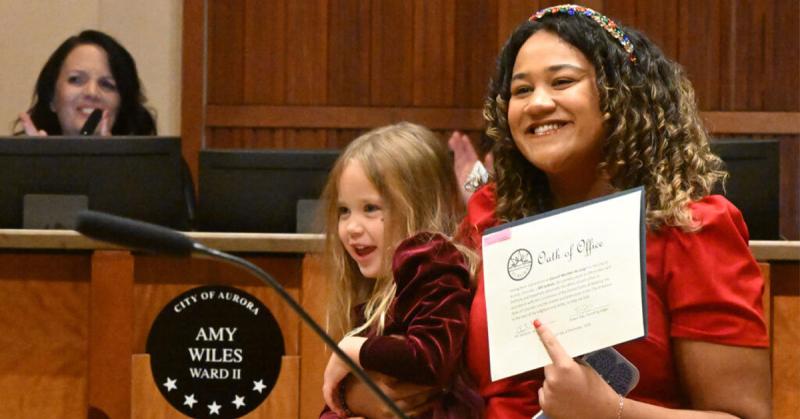
University of Denver Graduate School of Social Work (GSSW) faculty practice what they teach. That is certainly the case for alumna and Adjunct Instructor Alli Jackson (BA ’17, MSW ’18), who was sworn in as an unaffiliated at-large member of the Aurora, Colorado, City Council, on Dec. 1, 2025.
Jackson is part of a progressive majority that flipped the conservative council in November. Now she is working on the sorts of systems changes she learned about in her MSW program and teaches about in courses such as antioppressive practices; power, privilege, and oppression; and disproportionalities across systems.
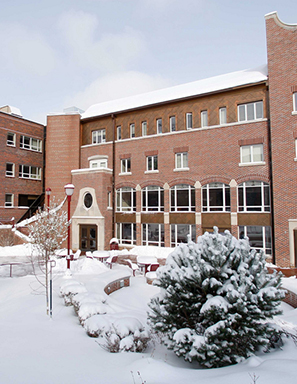
Jackson was raised in Aurora, the daughter of a Black father and an immigrant mother from Russia. She also has a sibling with a significant psychiatric illness. The unmet mental health needs in her own family inspired Jackson to pursue a psychology degree. However, she recalls feeling that psychology was too concerned with “changing the individual to fit into society.” Serendipitously, a campus shortcut led her to GSSW’s Craig Hall.
“I didn’t know what social work was.” Jackson did some research and found that social work was “what I wanted to do with mental health, but it’s more about looking at the systems and society to change to fit the person, which I like a lot better.”
Through GSSW’s 5-year undergraduate/graduate degree program, Jackson earned a bachelor’s degree in psychology and creative writing and an MSW with a mental health concentration and a certificate in animal-assisted social work.
After graduation, Jackson spent 18 months as a clinical case manager working with unhoused individuals at a Denver community mental health center. Many of her clients were Black people who were disproportionately affected by poverty and homelessness and were struggling, but she did not have resources to meet their needs. She went on to become a restorative justice coordinator at a startup charter school, a learning community coordinator working with diverse students at Aurora Community College, and then associate director of equity and social justice programs at Metropolitan State University of Denver. Now she is the diversity, equity, and inclusion facilitation specialist at the Arapahoe County public library system, where she conducts trainings and works closely with human resources to address microaggressions and other problematic behaviors.
Jackson has followed politics all along. “Being in the body I’m in, being a biracial Black woman, it is political.” She wondered how her hometown of Aurora, which is one of the most racially and ethnically diverse cities in the nation, could be represented by such a conservative city council. As she learned in her GSSW courses, the city’s four at-large council seats, which represent the entire city, tend to be elected by the neighborhoods with the most resources. Jackson notes that is the opposite of how the system should work.
She explains, “If you looked at Aurora’s track record, we’re segregated. We’ve got a southern part, it’s very wealthy, very well-resourced, and very white. And then as you get more towards Denver, towards East Colfax, it becomes more dense, the houses are smaller, a lot of immigrants, refugees, a lot of diversity. And so we had always had overrepresentation of the south side of Aurora with the wealth in these at-large positions.”
After several years of attending ward meetings regularly and thinking about running, Jackson declared her candidacy in early 2025. She was spurred on, in part, by a wave of tough-on-crime legislation that disproportionately affected the most marginalized residents without making the community safer.
Jackson recalls thinking, “This is injustice, and I knew from my education at GSSW that putting people in prisons doesn’t solve the issue, it only makes it worse.” Jackson says she also knew she had the knowledge to effect change on systems that needed it.
The race was an uphill climb. Jackson raised just $20,000 to her opponent’s $250,000, but “money doesn’t vote, people vote.” She set out to “give the people something to vote for.” Jackson ran on a community-first platform, emphasizing her goal to keep immigrant families safe and welcome and build a city where all residents have an opportunity to thrive. She knocked on thousands of doors and centered community voice at a time when the City Council was silencing community members protesting the police killing of Kilyn Lewis, an unarmed Black man.
On City Council, Jackson chairs the Housing, Neighborhood Services and Redevelopment Committee; is vice chair of the Federal, State and Intergovernmental Relations Committee; and is a member of the Planning and Economic Development Committee and the new Council Rules Committee. At the beginning of her four-year term, Jackson and other councilmembers are spending a lot of time “cleaning up the mess” left by the previous conservative council.
Inspired by the family of Kilyn Lewis, Jackson is looking for a path forward with police reform. “I was very frustrated when I would watch the grieving mother, who had come from out of state continuously to talk to City Council, demanding justice. And our City Council people would scream at her face, would be typing on their email, or would just completely be ignoring her.”
On the housing and homelessness front, Jackson is looking at ways to improve the city’s new navigation center and exploring whether the city’s camping ban should be repealed. Jackson is also helping to create new rules and norms for a council whose members used to bicker with one another during meetings and yell at constituents.
Another priority is creation of a Downtown Development Authority, which Aurora voters passed in November. Jackson says, “This is original Aurora, and it has been neglected for a long time. We want to be very mindful about reactivating it without displacing more people and honoring the history.”
She adds, “I am really excited to try to get a downtown Aurora going, to generate some revenue, have a nightlife, have a place where families can go. I live in this area.”
In a recent Westword interview, Jackson said, “A lot of the ethics of social work guide me, like dignity and worth of a person just for being a person.” She invites other social workers to join her in leading social change through local political action.
Although Jackson initially wondered whether she was qualified for elected office, “I resonated with the community that I was trying to represent. I was able to really use my people skills and my mental health background to connect with people. That made me qualified. There’s no certain qualification or degree or track — it is simply your motivation and the impact you want to make.”