Eco-Emotions & Social Work

Back to Article Listing

Author(s)

GSSW

Communication Team

Craig Hall
Communication Team"

gssw.communications@du.edu

GSSW faculty, staff and students are addressing the growing issue of ecological distress
News  •
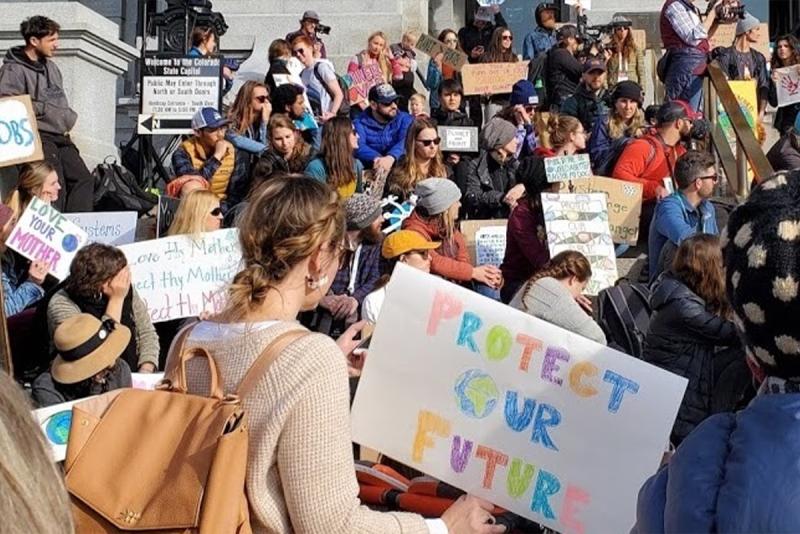
Activists at the 2020 Winter Outdoor Retailer Show climate strike demanding climate action now

Activists at the 2020 Winter Outdoor Retailer Show climate strike demanding climate action now. Source: Conservation Colorado

University of Denver students are extremely worried about the state of the environment. That’s a preliminary finding from a recent survey being administered to all enrolled students by scholars at the school’s Center for a Regenerative Future. They’re asking respondents about 14 different eco-emotions — feelings about the environment, nature and environmental degradation, including climate change — and the impact on their lives in areas such as sleep or decision-making.

Most respondents report feeling sad and hopeless. “They’re not optimistic. They worry about what they can eat or buy, and they’re fearful of having children,” says Graduate School of Social Work (GSSW) graduate Sarah Ball, MSW ’23, who facilitates research for the center. “I’m hoping this data informs the University in terms of how we’re going to support people going forward, because it’s going to continue getting worse.”

DU students aren’t alone. A recent Civic Science study found that 38% of U.S. adults report having some “eco-anxiety” — extreme worry about current or future harm to the environment caused by human activity. But of those ages 18–24, that number is 50%. Likewise, the latest Conservation in the West Poll of Western voters found the highest level of concern ever, even cutting across political party lines.
38% of U.S. adults, and 50% of those ages 18–24, report having some “eco-anxiety.”

In her own therapy practice, GSSW alumna and Adjunct Instructor Kristen Greenwald (MSW ’17, LCSW) has seen an increase not just in mild anxiety, but in panic attacks, depression, trauma and suicidal ideation related to ecological distress.

The University of Denver RadioEd podcast discussed ecological distress with GSSW MSW alumni and adjunct instructors Julia Senecal and Kristen Greenwald.

Listen

One of DU’s worried students is Asher Reid, an Ecological Justice MSW student, an intern with the Center for a Regenerative Future and co-lead for GSSW’s ECO Conscious student organization. Reid recalls that as an undergraduate sustainability major, professors would talk about heavy topics such as mass extinction and climate refugees, and then students would head off to the next class. “My nervous system just jacked up — the world as we know it is ending, but they gave us no tools to process that. The only way I knew how to cope with that was to shut down.”

To help others cope, Reid is co-facilitating a series of on-campus climate cafés — a space to safely share thoughts, feelings and experiences related to the climate and ecological crisis. “The core idea of the climate café is that we’re bravely choosing to sit with each other and our emotions — be they fear, awe, grief or anger,” Reid explains, adding, “I’m choosing to come out of denial, and part of that is learning to feel these issues within community.

Climate-Aware Therapy

Before joining the GSSW faculty, Clinical Associate Professor Sarah Bexell spent more than two decades doing wildlife conservation work. “My mental health was horrific. I was working on giant and red panda conservation in China and seeing no end to the suffering and death in front of me, and I didn’t have the words to talk about it.” When she sought help back home in the United States, however, a therapist “belittled all my fears.”

Now there’s an emerging niche of climate-aware therapists, explains Bexell, faculty director of DU’s Center for a Regenerative Future, which has been providing exposure to DU’s Health & Counseling Center staff as well as to interested and concerned staff and faculty across campus. Because the climate and environmental crisis isn’t going to improve in our lifetimes, Bexell says, “We have to respond and help people to build resilience in their own lives. It has to start on the psychological level.”

Greenwald is training new social workers to help. She teaches the course “Environmental Change Impacts and Resilience Strategies for Mental Health,” launched in 2023 as part of the school’s Ecological Justice specialization pathway. The course offers a clinical mental health understanding of eco-distress and climate trauma to prepare students to help others dealing with those issues. Students leave the class ready to be practitioners, Greenwald says, “whether it’s working in the policy world, or it’s in a community organizing world, or working on a disaster response team or as a therapist.”

CGTN interviewed Asher Reid, Julia Senecal and Katherine Erstad about eco-distress and the growing need for climate-aware therapists.

Watch

Although climate-aware therapy and environmental social work are a niche now, Mental Health MSW student Katherine Erstad hopes that will change. “When I look at the core values of social work, we need to make them more expansive to include nonhuman animals and the planet, which involves water and air systems,” she says. “We need to broaden what we expect of social work and not just be so human focused, because we don’t have humans without the whole package.”

Social work is an encompassing field, she adds. “We’re here to care, and we’re here to be voices for systems and people who don’t have a voice,” says Erstad, who plans to work as a climate-aware therapist. “The planet and all the beings who don’t speak a human language don’t have a voice that humans take the time to hear — we have to be that.”

Ways to Address Eco-Distress

GSSW alumna and Adjunct Instructor Julia Senecal (MSW ’19, LSW) notes that emotions such as grief and anger are healthy in response to a crisis. In her work teaching and as assistant director of the Center for a Regenerative Future, she tries to help students by validating their feelings and helping them to leverage their emotions to take “hopeful and intentional action.” She created the University of Denver undergraduate course “Leveraging Eco-Distress to Create a Regenerative Future” to help students do just that.

Action-based coping — feeling like you’re working on a solution — can be particularly effective, along with mindfulness and other practices to calm the nervous system, Greenwald adds.

Erstad starts every day with a walk, which she says helps her feel grounded. She also volunteers at a farm animal sanctuary and commutes via bus instead of car. She says making thoughtful choices and focusing on the things we can do in our own lives can make us feel better even when the future seems bleak.

From the micro to the macro, Reid hopes all social workers will begin to act on behalf of the planet, just as they do for their clients and communities. For instance, Reid says, start having conversations about how to make your agency more regenerative. “Don’t give up active hope,” they advise. “We each have a responsibility that can come from love and care and not just fear. It is past time for social workers to step up. We all have a role in creating a just and livable future.”

Bexell encourages students to envision what it would look and feel like to live in a regenerative future in a way that’s reciprocal with the land, water and all other species, and “to see these times as exciting instead of foreboding.”

“We’re just so lucky — we have the most amazing planet,” Erstad adds. “What we have here is so beautiful. I just want to help people realize that.”

CTA

If you’re experiencing eco-distress, ask for help. Students have access to a wide variety of mental health services, including drop-in appointments.

Learn More