Health & Housing in Rural Colorado
Author(s)
GSSW
Communication Team
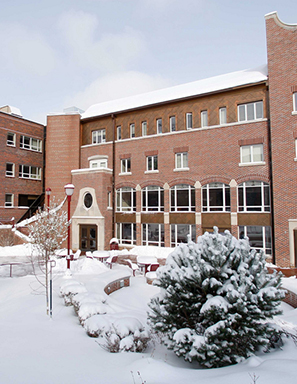
Summit explores health and housing challenges and solutions in rural Western Colorado communities
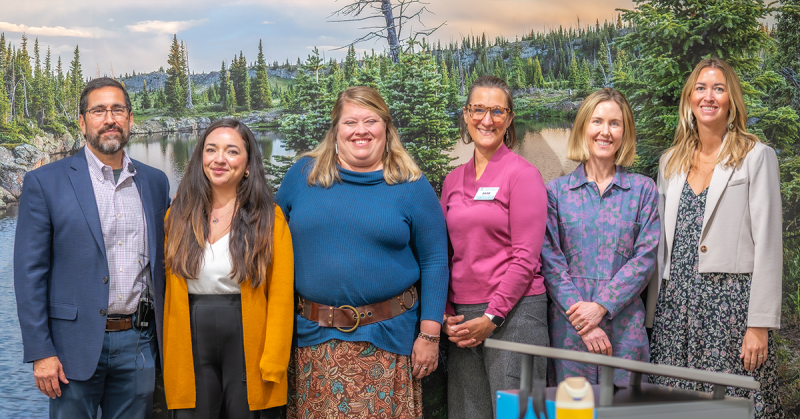
Clinical Professor Michael Talamantes (left) and Western Colorado MSW Program Director Rachel Forbes (right) are pictured with community panelists at the Western Colorado Health and Housing Summit.
High costs of living, housing, and health care are leading concerns for Colorado residents. These challenges are often more acute in rural Colorado, including the state’s Western Slope. Colorado’s mountain communities contend with some of the state’s highest housing costs, and rates of homelessness have soared, as have substance use and suicidality. Meanwhile, immigration crackdowns have destabilized families, businesses, and entire communities.
On March 12, the University of Denver Graduate School of Social Work’s (GSSW) Western Colorado MSW Program hosted the 2026 Western Colorado Health & Housing Summit in Glenwood Springs, Colorado. Supported by funding from the Aspen Community Foundation Giving Network, the summit focused on understanding the intersection of health, housing, and community well-being in Western Colorado.
The event was part of GSSW’s renewed emphasis on community engagement. Speakers included GSSW Associate Professor and Executive Director for the Center for Equity Research Shetal Vohra-Gupta, Clinical Professor Michael Talamantes, and Professor and Executive Director of the Center for Housing and Homelessness Daniel Brisson. Dean Henrika McCoy also gave an address at the event.
More than 80 community members attended the summit. Vohra-Gupta presented a talk and Q&A session titled “Beyond Social Determinants of Health (SDOH): Cultural Determinants as an Analytic Blind Spot in U.S. Health Research,” and Brisson presented a talk and Q&A titled “Permanent Supportive Housing and Dignified Design: The Built Environment as a Facilitator of Health and Well-Being.”
Talamantes facilitated a panel discussion titled “Behavioral Health Workforce Development and Community Partnerships: Addressing the Needs of Western Colorado,” which drew on local expertise from alumna Cristina Andrade (MSW ’19, LCSW), a behavioral health provider at Mountain Family Health Centers; alumna Barbra Corcoran (MSW ’15, LCSW, LAC, PMH-C), behavioral health director at Valley View Hospital; Cristina Gair, executive director of the West Mountain Regional Health Alliance; and alumna Lily Larkin (MSW, LCSW), chief clinical officer at the Aspen Hope Center. Talamantes says, “These organizations partner with GSSW — they help train our interns, they hire our graduates. They’re embedded in the community, working across the spectrum in health care, social services, behavioral health. There was a very robust discussion about concerns and needs. Housing was an underlying theme, one of the biggest needs in the valley, also transportation challenges, childcare challenges, basic needs that aren’t being met right now.”
GSSW’s Western Colorado MSW Program has been helping to grow the region’s behavioral health workforce in partnership with local communities for more than a decade, and panelists emphasized the ongoing need to train and employ homegrown talent rather than importing workers from elsewhere. Talamantes says, “Those are the folks who will be most dedicated to the wellness of that community.” The Aspen Community Foundation is supporting GSSW’s efforts by providing scholarships for MSW students in behavioral health internships in the Roaring Fork Valley.
Panelists also discussed the need for more collaboration among organizations and services, prevention efforts, bilingual and bicultural behavioral health providers, and a need to scale interventions beyond the individual level.
Talamantes adds, “This [summit] gave community members a more formal forum to have an existential conversation. It gave them more time for reflection: ‘Can we do this better?’ That opportunity for some reflection and dialog was important and powerful, giving people a bird’s eye view about what we need to do and who has agency.”
He notes that the summit was as much about what is working well as what is not. For example, Gair shared that organizations are establishing cross-sector collaborations on issues such as housing and transportation, and Valley View and Aspen Hope are working together to meet the needs of individuals experiencing psychiatric crisis.
Talamantes says that while GSSW brings expertise in social work education, research, and evidence-based interventions, the community members themselves are the experts on the specific problems their communities face and the solutions they need. He observes, “We need to be thoughtful about what our role is in rural communities. It’s a privilege that they’ve accepted us into their communities to [help grow] the workforce. It’s important to continue to reflect on that privilege and what else we can do to support them. We need to be available and present when they want some additional support, being a critical thought partner in meeting some of the challenges that they have and naming the successes that they have. They’re so innovative, so community based and focused; they’re being creative.”
Talamantes adds, “The summit was a nice vehicle to bring all that to the table.”
Professor of the Practice and Western Colorado MSW Program Director Rachel Forbes agrees. She says she often hears that there is a need for this type of event in rural Colorado, where practitioners do not always have access to the scholarship and research happening on the Denver campus. “This was an opportunity to bridge the rural–urban divide … to collaborate and learn from each other.” Forbes says she hopes the summit will be the first of many community convenings around practice concerns raised by the community.