Where Are They Now?
Author(s)
GSSW
Communication Team
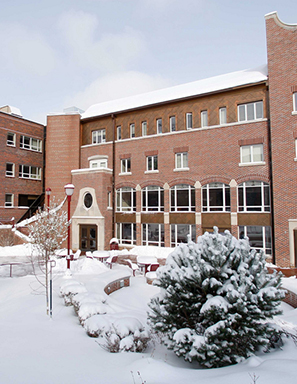
The work of Professor Emeritus William Cloud, PhD ’87, is featured in a new book on recovery capital

GSSW Professors Emeriti Walter LaMendola, William Cloud, Jeff Jenson, and Jim Moran gather to watch a recent Denver Broncos football game.
University of Denver Graduate School of Social Work (GSSW) Dean’s Circle member, alumnus, and Professor Emeritus William Cloud, PhD ’87, remembers mowing lawns as a boy and saving 75 cents so he could see the movie “Dumbo.” It was the late 1950s, and the Cloud family was living in segregated Chattanooga, Tennessee, following a move from the desegregated community of Gary, Indiana. Cloud’s mother explained that he could not see the film because the movie was being shown in a Whites-only theater.
It was one of Cloud’s earliest experiences with segregation. He recalls, “I will always remember that as an illustration of how Jim Crow laws affected people personally.” As someone who came of age in the Jim Crow South, Cloud had firsthand experience riding at the back of a bus and walking five miles across town to reach his “Colored school” when he did not have bus fare, passing closer Whites-only schools along the way. However, Cloud says, “I have also been witness to the progress that has been made for Black people, for women, for the GLBT community, the disabled community, caring for others, justice, inclusion.”
The injustices of poverty and racism helped lead Cloud to a long and fulfilling career in social work. In a 2020 interview, Cloud observed, “Many of the clients that we work with and study, the social problems we tackle, are born in disadvantaged communities.” He adds, “One of the reasons I got into social work was social justice — the ability to make some change.”
His personal experiences as a Black man also shaped Cloud’s leading contribution to the field: development of the recovery capital framework.
Cloud explains that recovery capital emphasizes the strength, resources, and social connections that individuals possess to support their recovery from addiction, assets that can to some extent be conferred or curtailed by social identity and systems of oppression. He and Robert Granfield began developing the framework in the 1990s. Today, recovery capital is a core concept in the study and treatment of addiction, drawing thousands of participants to an annual international conference.
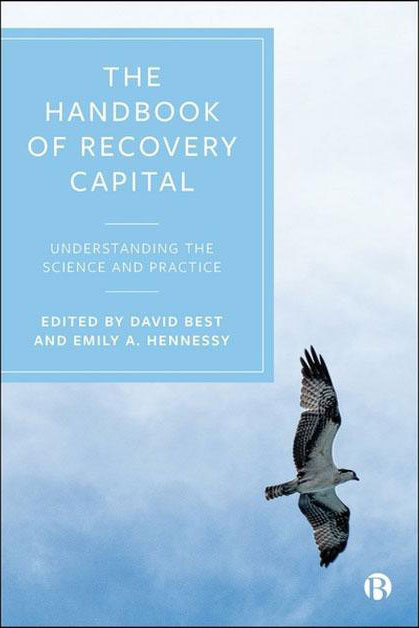
Granfield and Cloud recently contributed a chapter on recovery capital’s theoretical foundation to the “Handbook of Recovery Capital: Understanding the Science and Practice” (Bristol University Press, 2025). Edited by David Best and Emily Hennessy, the book summarizes the key evidence on recovery capital measurement and its application. Written for researchers, policymakers, practitioners, and people in recovery, the book demonstrates the impact of recovery capital in improving the quality of services available to people at different stages of recovery.
In the book foreword, William White writes, “Since the publication of [Granfield and Cloud’s] original 1994 paper, the term ‘recovery capital’ has appeared in the titles of more than 90 peer-reviewed scientific and medical articles and exerted a profound influence at policy, service practice, and personal recovery levels … The introduction of recovery capital into the field’s discourse was part of the larger shift toward a recovery paradigm. This shift extended the field’s vision and focus toward the successful, long-term resolution of [alcohol and other drug use] problems at personal, family, community, and cultural levels.”
White continues, “Traditionally, addiction recovery has been viewed as a process of subtraction — deleting [alcohol and other drug] use and its progeny of allied problems — with success measured by disordered individuals achieving a state of remission solely based on the cessation of drug use … In contrast, recovery capital proponents place great emphasis on recovery as processes of addition and multiplication — the acquisition of new assets, the achievement of global health and functioning and the potential to thrive and flourish, to get ‘better than well.’”
Recovery capital is, at its core, a justice-rooted paradigm that shifts a deficit-oriented viewpoint to a strengths-based perspective and repositions clients as experts in their own lived experience.