Faculty Book Spotlight
Author(s)
GSSW
Communication Team
Prof. Johnny Kim has published a new training manual for solution-focused brief therapy with families
University of Denver Graduate School of Social Work (GSSW) Professor Johnny Kim is counted among the world’s top 2% of scientists. His research focuses on clinical interventions to improve mental health outcomes for adolescents and families in community and school settings. He is regarded as one of the world’s foremost experts in solution-focused brief therapy (SFBT) and serves on the Research Committee for the Solution-Focused Brief Therapy Association. In November 2025, the association recognized Kim’s groundbreaking SFBT research and practice with the prestigious Steve de Shazer Award.
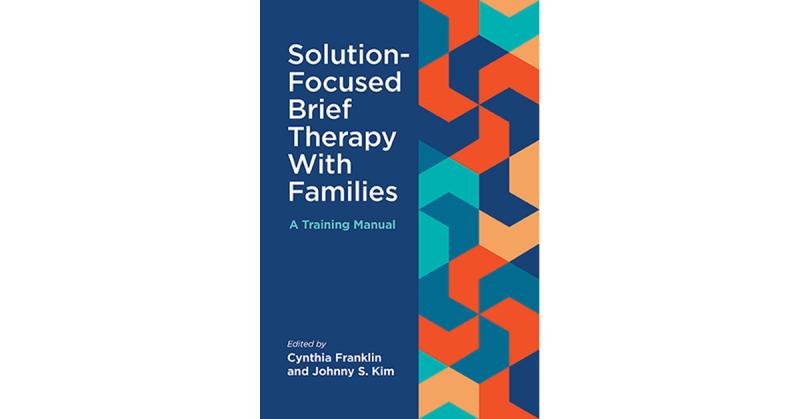
Kim has published five books on SFBT, including “Solution-Focused Brief Therapy with Families: A Training Manual” (American Psychological Association, 2025), which he co-edited with Cynthia Franklin, the Stiernberg/Spencer Family Professor in Mental Health at the University of Texas at Austin School of Social Work. Written with family psychologists and other therapists in mind, the training manual guides readers through the clinical practice of SFBT with families. The book includes an overview of SFBT, a brief history of its origins, underlying theory and research, and session sequencing and tools. The manual also teaches readers how to conduct an SFBT session from beginning to end. Detailed procedures and case examples illustrate practice with diverse clients in clinical and counseling settings, including challenges therapists may face working with families and how to avoid roadblocks in therapy.
Kim notes that the publication is one of the first books on SFBT in the American Psychological Association catalog and is the first to discuss how to apply SFBT to families. He says, “Solution-focused brief therapy is still relatively new to the psychology field, but there is tremendous interest in learning this therapy model.”
According to Mark Beyebach, an associate professor of psychotherapy at the Public University of Navarre, Pamplona and Tudela, “This much-needed manual presents a flexible and culture-sensitive, solution-focused approach to family therapy, grounded in research evidence and full of useful clinical examples and compelling case vignettes that offer detailed practice-based knowledge.”
Kim explains that most individual, couples and family therapy takes a problem-focused approach, delving deep to understand a problem over many sessions before beginning to address solutions. However, SFBT moves directly to solutions for a wide range of issues, including depression, addiction and trauma. Kim says, “We don’t have to spend a lot of time discussing the problem. We jump right into helping the client identify possible solutions and what the client wants their life to look like when the problem is gone. We don’t have to worry about uncovering the root cause of the problem to help clients figure out solutions. Instead, we focus on the preferred future self and what the client is doing different when they are at their best.”
Kim notes that research has shown SFBT to be as effective as other evidence-based therapy models, such as cognitive–behavioral therapy, and can help clients in fewer sessions. He adds, “The more tools we can give our clinicians, the better. I want to train social workers in a strength-based intervention so they can help their clients in the quickest amount of time.”