Advancing Aging Research
Author(s)
GSSW
Communication Team
GSSW faculty Leslie Hasche and Tyrone Hamler co-convene national social work research collaboration

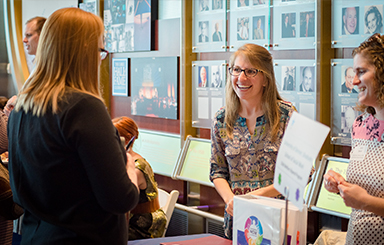
Nearly two dozen University of Denver Graduate School of Social Work (GSSW) scholars presented their research at the Society for Social Work and Research (SSWR) 30th Annual Conference, “Leading for Transformative Change: Aligning Social Work Science with Policy and Practice,” held Jan. 14–18 in Washington, DC. Presentations by faculty, staff, students and alumni spanned topics including universal basic income, weight bias, feminist narrative methods, environmental issues and more.
At the conference, Professor Ramona Beltrán and community partner Olga Gonzalez of Cultivando received the 2026 Community–Research Partnership Award. Read more about their work to document the health impacts of an oil refinery on Latine and Indigenous communities in Adams County, Colorado. Sponsored by Cognella, the award recognizes their collaborative work advancing community science.
GSSW faculty also co-convened three special-interest groups (SIGs) at the conference: Aging Research, Education, Advocacy, and Practice (co-conveners: Professor Leslie Hasche and Assistant Professor Tyrone Hamler); Abolitionist Social Work (co-convener: Assistant Professor Sophia Sarantakos); and Suicide Prevention and Intervention (co-convener: Associate Professor Anthony Fulginiti). SIGs bring together faculty, researchers and students from across the nation to discuss and collaborate on research.
Hasche leads the aging SIG, which she says emphasizes building collaboration among aging-focused organizations to elevate aging-focused research. In partnership with the Association for Gerontology Education in Social Work (AGESW), the aging SIG offered a 2025 webinar featuring leading scholars in gerontology and social work, who shared their expertise on crafting compelling conference abstracts. In 2026, more than 50 social work researchers attended the SIG, which Hasche says is an attendance record.
Hamler explains, “Our focus is to promote aging-related scholarship at SSWR, build community, explore future collaborative efforts, support doctoral students and encourage collaborations with AGESW.” He adds, “We also want to share our experiences with and opportunities for AGESW pre-dissertation fellowships (many of us are pre-dissertation fellowship alumni).”
Hasche is the University of Denver vice provost for faculty affairs and a fellow of the Gerontological Society of America (GSA). In partnership with social service and aging service providers, her research aims to understand how community-based services can best promote mental health, independence, safety, quality of life and overall wellness for older adults. Recent publications include “A Phenomenological Understanding of the Intersectionality of Ageism and Racism Among Older Adults: Interpersonal Experiences” in the Journal of Social Work, “Examining the Influences of Educational Computer-Gaming Play on Older Adults’ Learning Using the Biochemistry Video Game Foldit” in Biochemistry and Molecular Biology Education, and “LinkAGES Colorado: Implementing Intergenerational Programs to Improve Connections Across Generations” in the Journal of Community Practice.